

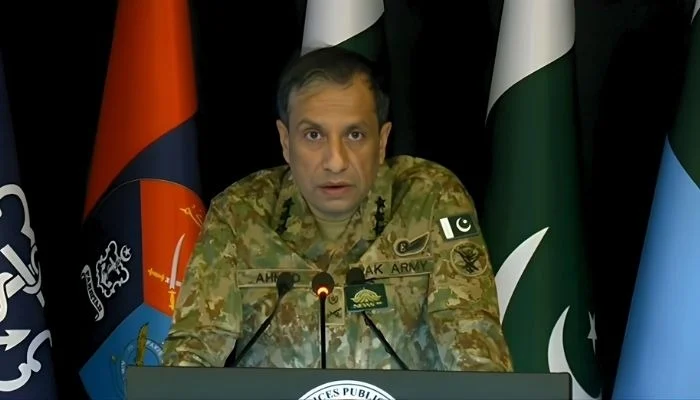

RAWALPINDI: Inter-Services Public Relations Director-General Ahmed Sharif Chaudhry on Tuesday strongly criticised the Pakistan Tehreek-e-Insaf leadership in Khyber Pakhtunkhwa, holding it responsible for the sharp rise in terrorism in the province.
Addressing a press briefing in Rawalpindi, the military spokesperson said the PTI-led provincial government was seeking help from Afghanistan while simultaneously resisting counterterrorism efforts at every forum.
He said nearly 71 per cent of terrorist incidents reported in 2025 occurred in Khyber Pakhtunkhwa, attributing the situation to what he described as a “politically conducive environment” and a flourishing political-criminal-terror nexus in the province.
Citing an annual report by the Centre for Research and Security Studies, the ISPR DG said fatalities in KP rose from 1,620 in 2024 to 2,331 in 2025, marking an increase of more than 40 per cent year-on-year.
He criticised KP Chief Minister Sohail Afridi’s stance on talks with militants and rejected calls for Afghan security guarantees, questioning opposition to counterterrorism operations. He said a false narrative was being built in assemblies and termed remarks against military operations as “ridiculous”.
“If you do not want a military operation, then what should be done — sit at the feet of khawarij?” he said, adding that seeking assurances from those accused of harbouring terrorists was illogical.
Speaking on regional security, the ISPR chief said Afghanistan had become a centre of terrorist operations and accused the Afghan Taliban regime of allowing its soil to be used against Pakistan. He said the nexus between Fitna al-Khawarij and India became fully exposed in 2025, posing a serious threat to regional peace.
He said Pakistani forces had responded decisively to attacks on border posts and reiterated that Islamabad targeted terrorist elements at the Afghan border in October 2025. “We targeted the TTP, not the Afghan Taliban,” he said.
Providing details of counterterrorism efforts, the ISPR DG said law enforcement agencies carried out 75,175 intelligence-based operations across the country in 2025. Of these, 14,658 were conducted in Khyber Pakhtunkhwa, 58,778 in Balochistan, and 1,739 in other parts of the country.
He said 5,397 terrorist incidents were reported nationwide during the year, with 3,811 in KP, 1,557 in Balochistan and 29 elsewhere. He added that 2,597 terrorists were killed during counterterror operations.
Referring to major attacks, he said civilians and soft targets were deliberately targeted and Afghan militants were involved in all major incidents. He said 21 civilians were martyred in the Jaffar Express attack and eight civilians were killed in an attack on the Frontier Corps headquarters in Quetta.
The ISPR chief rejected the narrative that the fight against terrorism was solely the military’s responsibility, calling it a national war involving every citizen. He stressed that Pakistan made no distinctions among terrorists and had no sympathy for any militant group.
Warning about the misuse of social media, he said online platforms were increasingly being used to promote terrorism and criminal activity, stressing the need for enforcement of laws to protect society.
Concluding the briefing, he said no individual or political party was above Pakistan and reaffirmed that the armed forces would continue the fight against terrorism until its complete elimination.
