

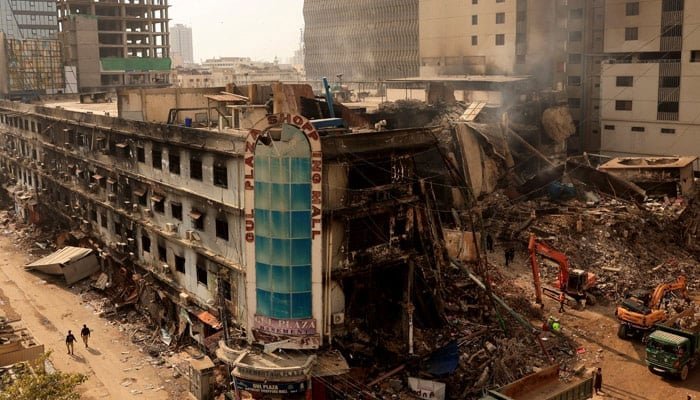

The Sindh government on Thursday released the findings of a committee investigating the devastating Gul Plaza fire, which claimed 79 lives in Karachi. The report provides a detailed account of the fire’s progression, emergency response, and systemic failures in safety and rescue operations.
According to the report, the fire broke out at shop number 193, a flower and gift shop on the ground floor, where the owner had left his 11-year-old son. Another 11-year-old boy from a neighboring shop was also present. The report notes that inflammable materials accelerated the fire’s spread to adjacent shops. Smoke quickly filled staircases and passageways, trapping hundreds of people.
The inquiry highlighted that between 2,000 and 2,500 shopkeepers and employees were inside the plaza at the time. While some gates were open, they were insufficient to prevent entrapment, and emergency exits were either blocked or encroached upon.
The committee observed major delays in water supply. Fire tenders were dispatched shortly after the fire was reported at 10:26pm, but the first water bowser arrived at 11:53pm. Continuous water supply did not begin until after midnight. Additional tankers from various hydrants arrived later, but response efforts were hampered by the lack of proper firefighting tools, protective gear, and trained personnel.
Police and district administration measures to control crowds and manage the site were deemed inadequate, further obstructing firefighting operations. The report also noted that multiple fire safety audits had been conducted in the past, but recommendations were ignored.
The committee recorded statements from 19 witnesses, including shopkeepers, a watchman, and injured persons, and reviewed available CCTV footage to reconstruct the sequence of events.
In its recommendations, the report called for:
-
Immediate audits of all high-risk commercial buildings.
-
Regular emergency evacuation drills for staff and occupants.
-
Upgradation of firefighting and rescue institutions with modern equipment.
-
Strict enforcement of fire safety compliance in commercial complexes.
The committee emphasized that the tragedy was preventable and highlighted the urgent need for systemic reforms in building safety, emergency preparedness, and institutional coordination.
