

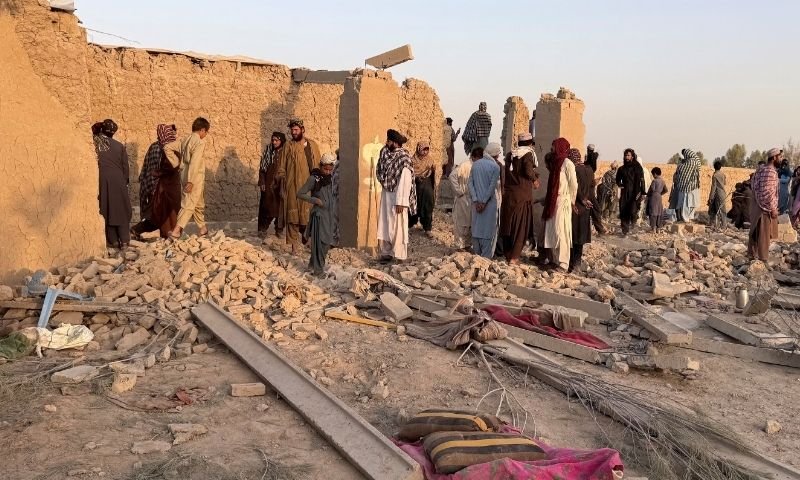

ISLAMABAD: Aerial strikes targeting alleged terrorist hideouts in Afghanistan killed 22 militants, the Ministry of Information and Broadcasting said on Thursday, as tensions between Pakistan and Afghanistan continued to escalate.
In a statement posted on X, the ministry said the “well-planned and calibrated” strikes were conducted as part of Operation Ghazab Lil Haq and the ongoing campaign against militants, their networks and supporters.
According to the ministry, the strikes were carried out on the basis of credible intelligence and targeted two locations in Afghanistan allegedly being used as camps and hideouts by organisations Pakistan refers to as Fitna al Khwarij and Fitna al Hindustan, along with their affiliates.
“Targets were destroyed with precision and initial reports suggest killing of twenty-two terrorists,” the ministry said, adding that large quantities of weapons and ammunition stored at the targeted locations had also been destroyed.
However, Afghan Taliban spokesperson Zabihullah Mujahid said women and children were among those killed in the strikes in Afghanistan’s Kunar and Helmand provinces, while 11 others were injured, Reuters reported. Mujahid condemned the strikes in a post on X, describing them as aggression and a violation of accepted principles.
The conflicting accounts could not be independently verified.
The ministry said the strikes were specifically aimed at alleged militant hubs and that maximum precautions had been taken to prevent civilian casualties and collateral damage.
“Pakistan has always strived for the maintenance of peace and stability in the region. However, the safety and security of our citizens remains our foremost priority,” it said.
The ministry expressed concern over what it described as Afghanistan’s continued role as a hub of terrorism, maintaining that threats to Pakistan emanated from Afghan territory.
It said the counterterrorism campaign under Operation Ghazab Lil Haq, within the broader Azm-e-Istehkam framework, would continue at full pace.
The armed forces and law-enforcement agencies would continue efforts to eliminate what the ministry described as foreign-sponsored and supported terrorism, it added.
Tensions along the Pakistan-Afghanistan border escalated in late September following a series of incidents and cross-border strikes.
On September 23, Pakistani security sources said eight drones allegedly entered the country’s airspace from Afghanistan and were intercepted by Pakistan’s air defence. Four were reportedly brought down near the Torkham border, while four others were shot down in mountainous areas near Kohat.
The sources said the incident followed Pakistani strikes on alleged Afghan Taliban positions in the Kurram sector a day earlier.
Information Minister Attaullah Tarar subsequently said Pakistan had carried out precision strikes on 10 locations in Afghanistan allegedly used to launch and store drones. He described the reported drone incursion as a violation of Pakistan’s sovereignty and said the strikes were limited to military objectives linked to the attempted attacks.
On September 25, Pakistani security sources said an attempted incursion by Afghan Taliban fighters had been thwarted in the Chaman border sector. They said Pakistani forces responded to firing by targeting Taliban positions with quadcopters and mortar fire.
Reuters reported that Afghan Taliban authorities had not immediately commented on those allegations.
The latest developments come amid continuing tensions over Pakistan’s allegations that militant groups operate from Afghan territory. Afghan authorities have denied allowing their soil to be used for attacks against Pakistan.
