

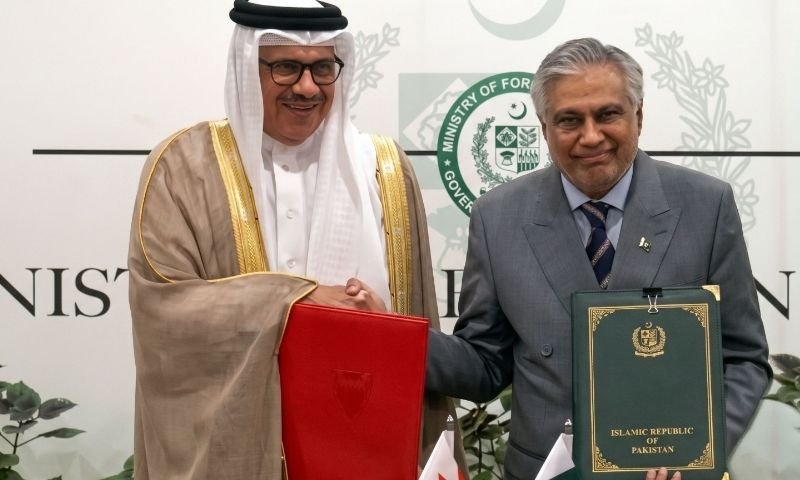

ISLAMABAD: Pakistan and Bahrain on Thursday agreed to establish a joint working group on trade and investment and push for the early finalisation of the GCC-Pakistan Free Trade Agreement as the two countries signed the agreed minutes of the third session of their Joint Ministerial Commission (JMC).
Deputy Prime Minister and Foreign Minister Ishaq Dar and Bahraini Foreign Minister Dr Abdullatif bin Rashid Al Zayani announced the agreements at a joint press conference following the JMC meeting.
Al Zayani said the minutes covered more than 15 areas, with the two sides agreeing to establish a joint working group on trade and investment and convene the joint working group on energy next month to discuss oil, gas and minerals.
The two countries also agreed to enhance cooperation in food security, information technology, law enforcement, media, labour mobility, health, education, culture and sports.
“We also committed to finalising the GCC-Pakistan Free Trade Agreement and will review progress at the fourth session in the Kingdom of Bahrain,” Al Zayani said.
He added that Bahrain, which currently holds the GCC presidency, was working to accelerate approval of the agreement. The two countries had also been given a mandate by their prime ministers to double bilateral trade within three years, he said.
Dar said the talks covered agriculture, energy, sports, tourism and business-to-business cooperation, adding that joint working groups would be established in specific sectors with the objective of increasing bilateral trade.
The two sides also reaffirmed their commitment to cooperation in labour mobility, vocational training and human resource development to create opportunities for skilled Pakistani professionals and workers.
The JMC meeting was held after a gap of five years. Dar said both sides would seek to make the forum an annual event and committed to visiting Manama for the fourth session in 2027.
“My brother has taken a commitment from me that unlike today’s session, which has been held after five years, the next one I have to find a day in 365 days during 2027,” Dar said, adding that he would fulfil the commitment.
The two foreign ministers also exchanged views on the evolving situation in the Gulf and stressed restraint, de-escalation, dialogue and diplomacy.
Dar said the two sides discussed the need to ensure the safety and freedom of navigation through the Strait of Hormuz and the Bab el-Mandeb, given their importance to global food and energy security.
“Pakistan remains committed to playing a constructive role in supporting diplomatic efforts for peace and stability in the region,” he said.
Al Zayani said commercial vessels continued to come under attack in both straits and expressed Bahrain’s appreciation for Pakistan’s positions during the crisis, including its support for UN Security Council Resolution 2817 and efforts to facilitate US-Iran dialogue, including by hosting talks in Islamabad.
As fellow non-permanent members of the UN Security Council, Pakistan and Bahrain would continue close coordination, he said.
Al Zayani also condemned attacks on Abha International Airport and King Khalid International Airport in Saudi Arabia on October 6 and 7, which he said resulted in deaths and injuries among citizens and residents.
He also condemned Houthi attacks targeting civilians and civilian facilities in Saudi Arabia, as well as attacks on Makkah and Madinah.
“Targeting airports and civilian facilities is a flagrant violation of international law and international humanitarian law, and a threat to the safety of civil aviation,” Al Zayani said, adding that Bahrain stood in full solidarity with Saudi Arabia.
On Palestine, Dar said Pakistan had reaffirmed its principled support for the Palestinian people and their inalienable rights.
The two sides expressed concern over the expansion of illegal settlements and attempts to alter the status of Al-Quds Al-Sharif, while stressing the need for unhindered humanitarian assistance to Gaza and a just and lasting solution in line with UN resolutions.
On South Asia, Dar said Pakistan had underscored the need to ensure that Afghan territory was not used against Pakistan.
Regarding the Indus Waters Treaty, Dar said he told his Bahraini counterpart that India’s unilateral decision to place the treaty in abeyance constituted a material breach of international law and amounted to an attempt to weaponise shared water resources.
He said such actions jeopardised the water, food and energy security of Pakistan’s 250 million people.
Asked to describe bilateral relations, Al Zayani said the ties were “very healthy and strong”, adding that they were valued by Bahrain’s king, crown prince and people.
He cited Prime Minister Shehbaz Sharif’s visit to Bahrain in November 2025 and President Asif Ali Zardari’s visit in January 2026 as examples of high-level engagement between the two countries.
“We have a very truthful relationship. We are so frank with each other. We understand the constraints on each other and we work accordingly,” Al Zayani said.
He noted that more than 140,000 Pakistanis were working in Bahrain and said the two countries were now looking for greater practical outcomes from their cooperation.
Dar said Al Zayani had remained in contact during the India-Pakistan war in 2025 and Pakistan’s efforts to facilitate US-Iran dialogue, regularly seeking updates on developments.
“We are connected on all international fora, we support each other, we consult each other,” Dar said.
Al Zayani said Pakistan and Bahrain would mark 55 years of diplomatic relations on October 14. He also highlighted the King Hamad University for Nursing and Allied Medical Sciences in Islamabad.
The Bahraini foreign minister was scheduled to call on President Zardari, Prime Minister Shehbaz and Field Marshal Syed Asim Munir later on Thursday.
Dar said Pakistan and Bahrain remained committed to taking bilateral trade and economic relations “to new heights”.
