

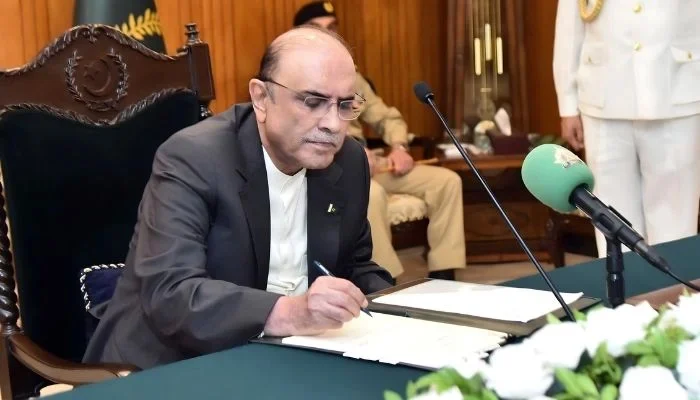

ISLAMABAD: President Asif Ali Zardari on Sunday imposed an emergency in Khyber Pakhtunkhwa under Articles 232(1) and 234(1) of the Constitution, citing a deteriorating law and order situation, an increase in terrorist attacks and what the federal government described as the provincial government’s failure to effectively tackle terrorism.
The proclamation, which came into force with immediate effect, allows the federal government to direct the KP governor to assume some or all functions of the provincial government. It also provides for the powers of the provincial assembly to be exercised by Parliament or under its authority, effectively placing key provincial affairs under federal direction.
According to the proclamation, the chief minister, provincial ministers, advisers, special assistants and advocate general will immediately cease to hold their offices.
The president’s decision followed a recommendation by the federal cabinet, which reviewed the province’s security situation and expressed concern over what it described as the provincial government’s deliberate disengagement from the fight against terrorism.
The proclamation said the growing number of terrorist attacks and worsening law and order situation had created serious risks to the lives and property of citizens. It also referred to attacks on government installations, critical infrastructure and law enforcement agencies, describing the escalation in violence as an extraordinary threat.
The proclamation accused the provincial government of failing to demonstrate the commitment and take the necessary measures required to counter terrorism and lawlessness effectively.
It further cited a report by the KP governor, which identified what it described as a breakdown of constitutional machinery and indicated that the provincial government was unable to function in accordance with the Constitution.
In view of the situation, President Zardari considered immediate constitutional intervention necessary, the proclamation said.
Under the arrangement, the governor may perform the functions of the provincial government assigned by the federal government. Other provincial institutions and authorities will exercise their powers in accordance with federal directions, while the powers of the KP Assembly will be exercised by Parliament or under its authority.
Meanwhile, the federal government appointed Grade 22 Pakistan Administrative Service officer Dr Mohammad Fakhr Alam Irfan as the chief secretary of Khyber Pakhtunkhwa with immediate effect.
According to a notification issued on October 11, Dr Irfan, who was previously serving as secretary of the Power Division at the Ministry of Energy, will remain in the position until further orders. He belongs to Mardan district of Khyber Pakhtunkhwa.
His appointment comes amid the constitutional intervention in the affairs of the Pakistan Tehreek-e-Insaf (PTI)-governed province, placing key provincial executive functions under federal direction.
Earlier, the federal cabinet, chaired by Prime Minister Shehbaz Sharif, was briefed on the security situation in the province and reviewed the growing threat posed by terrorism, according to a statement issued by the Prime Minister’s Office.
The cabinet advised the prime minister to recommend that President Zardari invoke his constitutional powers to impose an emergency in KP. The prime minister’s advice was subsequently sent to the Presidency, the statement said.
The move involves two distinct constitutional provisions. Article 232 deals with the proclamation of an emergency when Pakistan’s security, or that of any part of the country, is threatened by war, external aggression or internal disturbance beyond the control of a provincial government.
In cases involving internal disturbance beyond a provincial government’s ability to maintain control, Article 232 requires a resolution from the provincial assembly concerned. If the president issues a proclamation without such a resolution, it must be placed before both houses of Parliament for approval within 10 days.
An emergency under Article 232 expands the federal government’s authority over the province. Parliament may legislate on provincial matters outside the Federal Legislative List, while the federal government may issue directions concerning the exercise of provincial executive authority. The provision does not, by itself, automatically transfer the powers of the provincial assembly to Parliament.
Article 234, meanwhile, addresses a breakdown of constitutional machinery in a province. The president may issue a proclamation under this provision after receiving a report from the provincial governor and being satisfied that the provincial government cannot be carried on in accordance with the Constitution.
Under Article 234, the president may assume some or all functions of the provincial government or direct the governor to exercise those functions. The president may also provide for the powers of the provincial assembly to be exercised by or under the authority of Parliament. The provision does not authorise the president or governor to assume the powers of a high court or suspend constitutional provisions relating to high courts.
Unlike Article 232, Article 234 does not require a resolution from the provincial assembly. A proclamation under Article 234 must be placed before a joint sitting of Parliament and will cease to operate after two months unless approved by a resolution of the joint sitting. It may be extended through further resolutions, but cannot remain in force for more than six months.
Earlier on Sunday, Prime Minister Shehbaz Sharif vowed not to allow PTI supporters to enter Islamabad as part of the party’s planned long march, accusing the party and the KP government of failing to cooperate with the federal government in tackling terrorism while maintaining that the government remained ready for dialogue.
Addressing the federal cabinet meeting, the prime minister questioned whether the PTI-led provincial government would continue to remain a silent spectator as terrorist attacks increased in the province. He said the law would take its course and that he would not allow a repeat of what he described as attempts to disrupt the country.
“They have now planned an attack on Islamabad,” Shehbaz said, referring to the PTI’s planned march towards the federal capital.
He questioned whether the KP government intended to repeat the same course of action and said the march would not be allowed to enter Islamabad.
The prime minister said the federal government, along with the Pakistan Peoples Party (PPP), had sent a delegation to engage with the PTI leadership, indicating that efforts had been made to resolve political differences through talks.
