

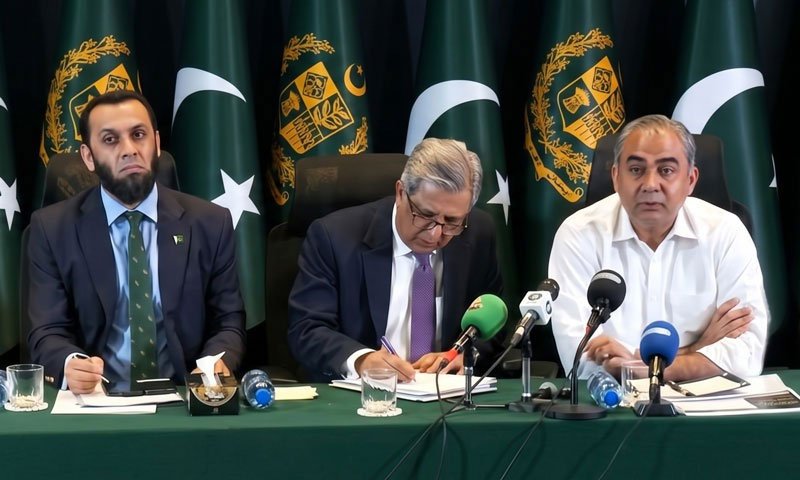

ISLAMABAD: The federal government has established an 11-member advisory council to assist Khyber Pakhtunkhwa Governor Faisal Karim Kundi and a separate administrative secretariat to oversee 12 terrorism-affected districts, Law Minister Azam Nazeer Tarar said on Sunday, as the government defended its decision to impose an emergency and governor’s rule in the province.
Addressing a press conference alongside Information Minister Attaullah Tarar and Interior Minister Mohsin Naqvi, the law minister said President Asif Ali Zardari had invoked Articles 232 and 234 of the Constitution on the advice of Prime Minister Shehbaz Sharif after consultations and unsuccessful negotiations with the provincial government.
He said the federal government had also issued a fresh proclamation under Article 245 to enable the armed forces to assist the provincial administration in counterterrorism efforts.
Tarar said the constitutional measures were taken in response to what the government described as an exceptionally serious security situation, with terrorist attacks and extremist activities posing a grave threat to lives and property in the province.
He said negotiations with the provincial administration continued until 2:30am but failed to resolve the differences.
Explaining the constitutional basis for the decision, Tarar said Article 149(4) empowered the federal government to issue directions to provinces on matters relating to public order and Pakistan’s security. Article 232 provides for an emergency in qualifying circumstances involving threats to national security, while Article 234 deals with situations in which a provincial government cannot function in accordance with the Constitution.
He said the security situation along the Pakistan-Afghanistan border, combined with internal threats in KP, had created circumstances warranting the invocation of these provisions.
According to Tarar, the federal government had assessed available reports and evidence and concluded that the conditions for invoking both articles had been met.
Under the new administrative arrangements, an 11-member advisory council will assist Governor Kundi during the interim period. A separate secretariat has also been established for 12 districts where, according to the government, the security situation is particularly severe.
The secretariat will operate under the governor and chief secretary, overseeing administrative matters in the designated districts and keeping the federal government informed about developments on the ground.
Information Minister Attaullah Tarar announced the portfolios of the advisory council, saying its members included former civil servants, legal experts, academics, public-sector professionals and political representatives selected for their experience.
Retired Lieutenant General Nigar Johar has been assigned the health portfolio, former Federal Board of Revenue chairman Tariq Mahmood Pasha will oversee finance, while National Assembly member Samar Haroon Bilour has been given information and broadcasting.
The other members and their portfolios are Kifayatullah Khan for home affairs, Amir Javed for law, Dr Syed Amir Abdullah for education, Dr Sarfaraz Ali Shah for mines and minerals, Dr Muhammad Irshad for industries and commerce, Asif Rafiq Afridi for communications and works, local government, housing and transport, Tayyab Qureshi for religious affairs, and former senator Osman Saifullah Khan for energy.
Attaullah Tarar said the council would work under the governor to improve governance and public service delivery while the provincial government’s executive functions remained suspended under the new arrangement.
He also announced that an Area Reconstruction and Development Council would handle reconstruction and development matters in the affected districts, with an officer of additional chief secretary rank serving as administrator.
The information minister said the 12 districts had been notified and would receive greater administrative attention through the new mechanism involving the governor and the federal government. He said the arrangements were intended to improve coordination, address security challenges and ensure that development work continued in areas affected by militancy.
Tarar said the proclamation had rendered the offices of the KP chief minister, provincial ministers, advisers, special assistants and advocate general inactive with immediate effect. The governor would exercise the provincial government’s functions assigned to him by the federal government under the proclamation and subsequent orders.
He added that the fresh proclamation under Article 245 was intended to strengthen coordination between the armed forces and the provincial administration. Troops were already deployed in the province and conducting operations against militants, he said.
The information minister described the security situation as a threat extending beyond KP, citing the Global Terrorism Index and saying Pakistan had been ranked the country most affected by terrorism for the first time. He argued that improving security was essential for economic growth and attracting foreign investment.
Interior Minister Mohsin Naqvi said the federal government had made extensive efforts over more than a month to secure the provincial administration’s cooperation in combating terrorism before imposing emergency and governor’s rule.
Naqvi claimed militant activity had increased by 195 per cent in the province over approximately 18 months, while casualties among security personnel had risen by around 113 per cent over roughly 31 months.
Citing figures he said were official, the minister stated that 518 police personnel had been killed between January 2024 and the period covered by the data he presented. He said 12 districts faced particularly serious security challenges, including restrictions on residents’ movement after dark, targeted killings of police personnel and attacks on other officials.
Naqvi said he had held several meetings with former chief minister Sohail Afridi, focusing exclusively on counterterrorism rather than politics.
He said the federal government had proposed strengthening the police force in five districts during the first six months, allowing the army and Frontier Constabulary to withdraw from those areas as the police took over responsibility. The same approach would then be extended to another five districts over the following six months.
According to Naqvi, the provincial government had raised concerns about funding, prompting him to offer federal assistance to cover any shortfall. He said the proposal had been discussed around four months earlier but had not been implemented.
The minister also claimed that the provincial government had agreed during negotiations that an emergency should be imposed in 12 districts to restore normal life and address residents’ problems.
Naqvi rejected the suggestion that the federal decision was politically motivated, saying his ministry had sought the provincial government’s cooperation exclusively on counterterrorism. He maintained that an agreement on the proposed plan could have prevented the current situation and said efforts to reach an understanding continued until the previous night.
He also rejected suggestions that the separate administrative arrangement for the 12 districts amounted to dividing KP or creating a new province. The arrangement, he said, was intended to direct more resources and administrative attention towards areas affected by terrorism.
During the question-and-answer session, Naqvi said some PTI leaders had been taken into preventive custody following the suspension of the provincial government. He said individuals required to maintain law and order could be detained preventively, while those wanted in criminal cases would be arrested and dealt with under the law.
“Those who are wanted will be arrested, and the rest will be sent home as soon as the law-and-order situation improves,” he said. The minister did not provide a confirmed number of PTI lawmakers or leaders detained at the time of the press conference.
Asked how long the emergency would remain in force, Azam Nazeer Tarar said its duration would depend on the security situation and the applicable constitutional framework. He said a proclamation under Article 234 required parliamentary approval and could not remain in force for more than six months.
Naqvi also claimed that intelligence agencies possessed evidence of links between members of the former provincial administration and the Taliban, but did not publicly detail the alleged evidence or identify the individuals concerned.
“There is evidence — not one, not two or three, but dozens,” he said.
The interior minister further said Pakistan had held discussions with Afghan authorities in Saudi Arabia and Qatar, with China and Turkiye also involved in diplomatic efforts. He said Islamabad wanted an unequivocal commitment from the Afghan government to cooperate in combating terrorism.
Information Minister Attaullah Tarar accused the former provincial administration of allowing militant groups to gain influence in parts of KP and alleged that some districts had effectively been left at their mercy. He also accused the provincial government of insufficient attention to public safety and governance.
The minister criticised proposed changes to police recruitment, alleging that a provincial bill could create opportunities for people linked to militant groups to enter the force. However, he did not provide the text of the legislation or detailed evidence during the press conference to substantiate that claim.
Naqvi said the federal government would provide the provincial police, paramilitary forces and army with the resources required to combat terrorism, while declining to disclose operational details of the counterterrorism strategy.
He also said outstanding compensation for people displaced by security operations, including residents of South Waziristan and Tirah, should be prioritised.
Azam Nazeer Tarar said Prime Minister Shehbaz Sharif had sought to pursue dialogue before the decision was taken. He said Jamiat Ulema-e-Islam-Fazl chief Maulana Fazlur Rehman had met the prime minister, while further contacts had taken place the following morning.
According to Tarar, the federal cabinet had tasked Naqvi and Deputy Prime Minister Ishaq Dar with making a final effort to resolve the situation. Cabinet members were also briefed by officials from the interior and defence divisions, including on reports and material that could not be disclosed publicly for national security reasons.
Responding to a question about the role of Chief of Defence Forces Field Marshal Asim Munir, Tarar said he had no role in the constitutional framework governing the decision. He said the move had been taken through the constitutional process, with the prime minister exercising the relevant authority and the president’s satisfaction required under the applicable provisions.
The ministers said the government’s immediate priority was to restore security and normalise conditions in Khyber Pakhtunkhwa.
