

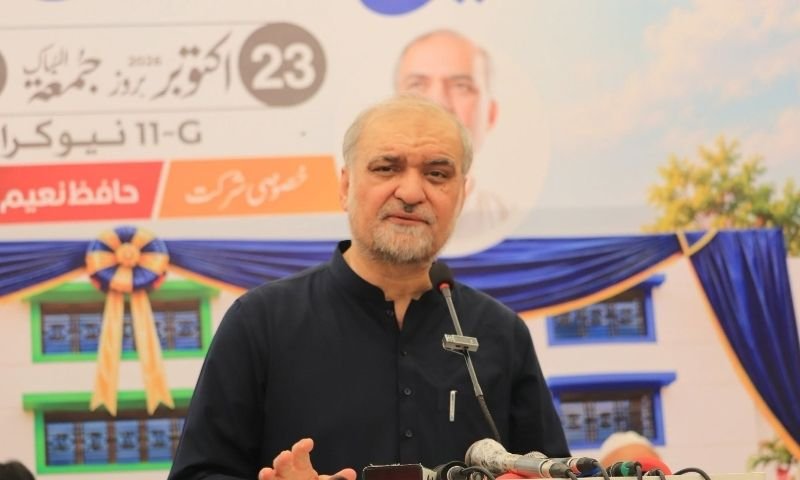

KARACHI: Jamaat-e-Islami (JI) chief Hafiz Naeemur Rehman on Friday announced protests and sit-ins in 150 cities across Pakistan against the petroleum levy, warning that the party was preparing a long march to Islamabad if the government failed to provide relief to the public.
Addressing a press conference in Karachi, Hafiz Naeem said the party was launching the third phase of its campaign against inflation and would continue its protest movement until the government addressed the rising cost of living and reduced petroleum prices.
He accused the ruling Pakistan Muslim League-Nawaz (PML-N) leadership of pursuing what he described as “economic terrorism” through heavy taxes on petroleum products, high electricity bills and persistent gas shortages.
The JI chief said the government was collecting between Rs135 and Rs140 per litre of petrol in taxes and levies, describing the amount as “extortion” and a “goon tax”.
He demanded the withdrawal of an additional Rs80 per litre petroleum levy, a Rs5 climate support levy and Rs21 in customs duty and other taxes, arguing that removing these charges would significantly reduce fuel prices.
Hafiz Naeem said the government’s existing petrol subsidy scheme was insufficient, particularly for low-income households and the middle class. He noted that around 25 million people relied on motorcycles for transportation and were among those most affected by rising fuel costs.
He claimed that abolishing the additional levies could reduce petrol prices by Rs100 to Rs125 per litre. Prices could fall below Rs200 per litre if the levies were withdrawn and international oil prices also declined, he added.
The JI chief maintained that lower fuel prices would ease inflationary pressure and support economic activity, saying the party would continue its campaign until the government delivered meaningful relief.
On the proposed long march, Hafiz Naeem said discussions were underway regarding a possible meeting with Prime Minister Shehbaz Sharif. He said government ministers had contacted JI Deputy Emir Liaquat Baloch on Thursday to discuss the matter.
However, he stressed that any meeting must produce concrete relief for the public.
“We have no particular desire for a meeting that does not provide relief to the people,” he said, adding that preparations for a long march were underway and further details would be announced in due course.
He warned that stopping the march would not be easy once the party decided to move towards Islamabad.
JI had launched a “super long march” from Karachi on September 21 to protest against the petroleum levy but suspended it two days later following initial contact from the prime minister. Hafiz Naeem had then described the postponement as a goodwill gesture in response to the prime minister’s outreach.
The JI chief also criticised high electricity bills, arguing that consumers were paying capacity charges to independent power producers (IPPs) for electricity that was not generated.
He alleged that the government had entered into unfair agreements with power producers and that the public was bearing the cost through excessive electricity bills. Taxes and capacity charges, he said, accounted for a substantial portion of bills, adding to the burden on households already struggling with inflation.
He demanded immediate measures to reduce these charges and provide relief to consumers.
Highlighting gas shortages, Hafiz Naeem said households were being forced to rely on liquefied petroleum gas (LPG), whose prices had risen sharply. He said families were facing mounting pressure from simultaneous increases in food, fuel and utility costs.
The JI chief also criticised the Punjab government over wheat shortages, farmers’ difficulties and rising flour prices. He alleged that agricultural policies had discouraged farmers from growing wheat, increasing the country’s reliance on imports.
He further accused the Sindh government of failing to address land-grabbing and law-and-order problems, particularly in Karachi, where he said robberies and other crimes remained a serious concern.
Questioning the provincial government’s performance in education, Hafiz Naeem claimed that Sindh had around 41,000 schools. He challenged Pakistan Peoples Party Chairman Bilawal Bhutto Zardari to identify a school in the province where he would be willing to enrol a child from his own family.
The announcement marks a renewed push by JI to pressure the government over fuel prices, electricity costs, gas shortages and other economic concerns through a nationwide protest campaign.
