

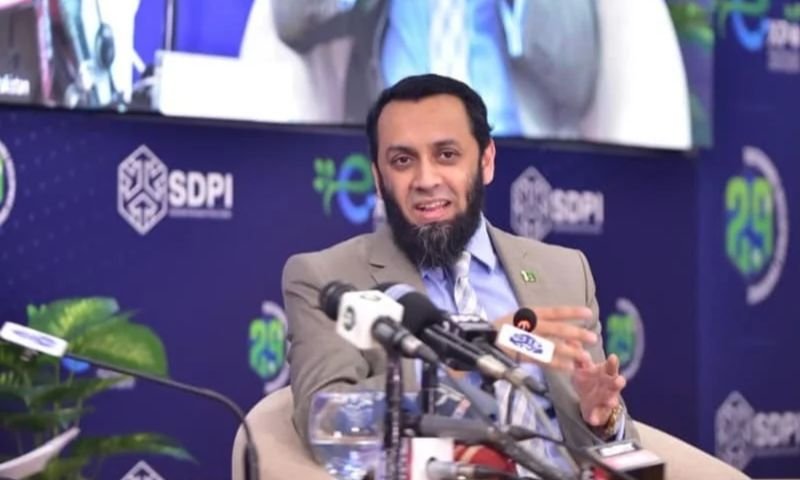

ISLAMABAD: Information Minister Attaullah Tarar has called for stronger regulation of social media platforms, improved fact-checking mechanisms and greater public awareness to counter misinformation, disinformation and fabricated content.
Speaking at the Sustainable Development Policy Institute (SDPI) in Islamabad, Tarar said social media algorithms prioritised engagement, including views, clicks, likes and reposts, rather than the accuracy of information.
“In a typical media set-up, the gatekeeper of information was the editor. But now … the gatekeeper of information is an algorithm,” he said, adding that algorithms had no inherent verification mechanism and were designed to maximise user engagement.
The minister said the government was engaging with social media platforms to encourage the labelling of artificial intelligence-generated content. He cited TikTok’s policy of requiring labels for content created wholly or partially using AI.
Tarar said a more robust regulatory framework was needed for social media platforms, where editorial filters traditionally found in electronic media were largely absent.
He also called for stronger internal fact-checking mechanisms on platforms such as X, citing its Community Notes feature as an example of how users could be alerted when old footage was circulated as a recent event.
The minister identified three key areas requiring attention: improved coordination with social media platforms and stronger fact-checking systems; capacity-building and public awareness; and collaboration with educational institutions to introduce courses on algorithms, digital media and fact-checking.
Tarar said the government had established Pakistan’s first Digital Communication Department after he assumed charge as information minister, following amendments to the ministry’s rules of business.
He said the department brought together graphic designers, video editors, content creators and scriptwriters to verify information and communicate it through formats suited to different audiences and platforms.
He stressed that digital communication required a tailored approach, as content effective on TikTok might not necessarily work on Instagram, Facebook or X.
The minister said the government was also working with the United Nations Development Programme (UNDP), the Institute of Business Administration (IBA) and other ministries to strengthen its information-verification capacity. He called for specialised courses in mass communication, journalism and digital media.
On communication during emergencies, Tarar said information should be released in stages as facts were verified. Authorities could initially confirm that an incident had occurred and subsequently share further details in coordination with relevant agencies, he added.
He said effective crisis communication required coordination among the government, state institutions, media organisations and social media platforms.
Referring to the conflict with India during Marka-e-Haq, Tarar said false and fabricated information had been circulated by India before, during and after the conflict. He said Pakistan had responded by sharing evidence, including video footage and verified accounts of events.
The minister praised Pakistani journalists, anchors, reporters and young social media users for what he described as responsible conduct during the conflict. He also highlighted memes created by Gen Z users as part of the public response.
Tarar said coordination with Director General Inter-Services Public Relations Lieutenant General Ahmed Sharif Chaudhry had helped ensure the timely sharing of information with television channels and digital platforms.
He also called for stronger laws to address crimes in the digital space and proposed an international convention to tackle the harmful use of artificial intelligence, including misinformation, disinformation and fabricated content.
The minister said Pakistan needed an effective domestic legal framework to deal with cybercrime, online harassment and the misuse of AI-generated audio and video.
He said the National Cyber Crime Investigation Agency (NCCIA) had been established to investigate offences committed in the digital space, with regional offices being set up and personnel receiving training.
Tarar also defended the Prevention of Electronic Crimes Act (PECA), saying it was intended to prevent electronic and cybercrime rather than restrict freedom of expression or obstruct journalists from performing their professional duties.
Asked whether Pakistan was prepared to deal with AI-generated audio and videos used to defame individuals, violate privacy or target governments, he said both domestic legislation and international cooperation were necessary.
He said he had proposed an international convention on the harmful use of AI at two international conferences, one in Riyadh and another in Istanbul. The proposed agreement could be backed by an international organisation or body, with countries joining as member states, he added.
Tarar said the misuse of AI also posed challenges to creative industries, including advertising and filmmaking, and could affect employment opportunities for people working in creative fields.
“A lot of our creative talent is going out of jobs,” he said, referring to professionals involved in developing creative concepts, modelling and other industry-related work.
He stressed the importance of retaining human involvement in the use of AI, saying the technology should not be allowed to replace human creativity entirely.
The minister described the establishment of the NCCIA as an important step towards addressing online harassment and cybercrime. He cited cases involving women being blackmailed or receiving inappropriate messages, as well as offences related to child sexual abuse and exploitation.
He also referred to a social media post by a hardliner offering a bounty for the killing of a former chief justice, questioning whether authorities had previously been equipped to deal with such threats.
“Were we able to address that issue? The answer is no, because there was no regulatory framework,” he said.
Tarar said the NCCIA, operating under the legal framework of PECA, would provide citizens facing online threats with a platform to seek redress and pursue legal action against those responsible.
He called for greater public awareness, particularly among marginalised groups, so people knew where to report cybercrime and how to seek protection.
The minister also said the Social Media Regulatory and Protection Authority had been established and its chairperson appointed. He said the authority would develop gradually as legal precedents, regulations and procedures evolved.
Addressing concerns that PECA could affect journalists’ ability to report and hold the government accountable, Tarar referred to existing regulatory bodies overseeing different aspects of the media industry.
These include the Pakistan Electronic Media Regulatory Authority (PEMRA), the Press Registrar, the Audit Bureau of Circulations, the Press Council and the Council of Complaints. He also mentioned the Implementation Tribunal for Newspaper Employees (ITNE), which deals with disputes involving newspaper employees.
“PECA is purely for the prevention of electronic crimes and crimes committed in cyber and digital spaces,” he said, maintaining that the law was not intended to restrict freedom of expression or prevent journalists from carrying out their professional duties.
Tarar said the legislation was designed to protect people facing threats and defamation through digital platforms.
He also called for stronger defamation laws, saying individuals and organisations with the financial means often pursued such cases abroad, including in the United Kingdom.
The minister maintained that PECA was intended to address threats arising from the cyber and digital space, where he said there was no other dedicated body to deal with such offences.
