

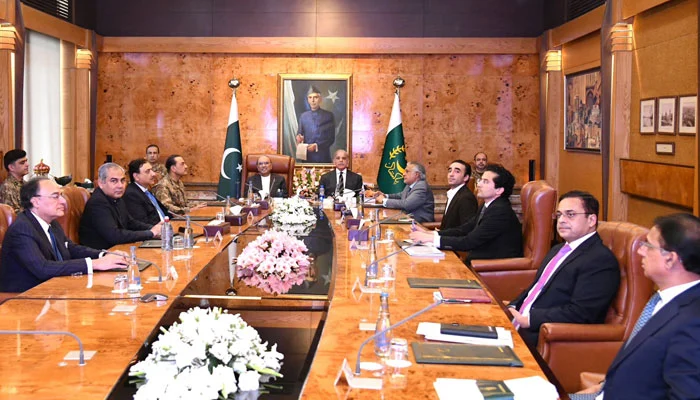

ISLAMABAD: Pakistan’s top civil-military leadership on Thursday endorsed a unified policy approach through consensus and institutional coordination to safeguard the country’s security, economy and food supply amid evolving regional challenges.
The decision was taken during a high-level consultative meeting chaired by President Asif Ali Zardari at Aiwan-e-Sadr, which reviewed the economic and energy situation in light of rising petroleum prices, oil supply constraints and ongoing regional tensions.
Prime Minister Shehbaz Sharif and Chief of Army Staff Field Marshal Syed Asim Munir attended the meeting, along with senior cabinet members and key political leadership.
According to a statement issued after the meeting, participants reviewed the impact of global fluctuations in oil and gas supplies on Pakistan’s economy, focusing on managing inflationary pressures and ensuring energy security.
Finance and petroleum officials briefed the participants on measures being taken to stabilise fuel prices, mitigate the impact of rising costs on various sectors and enforce fiscal discipline through austerity policies.
The broader regional situation also came under discussion, particularly its implications for Pakistan’s security environment, economic outlook and food security. Participants stressed the need for a coordinated national response to address these challenges effectively.
The meeting underscored the importance of maintaining national consensus and strengthening institutional coordination, noting that policy decisions must prioritise stability while protecting public interests.
It was agreed that economic management, energy planning, food security and security considerations must remain closely aligned to navigate the evolving situation.
Participants also emphasised the need to raise public awareness about reducing fuel consumption, promoting the use of public transport and encouraging ride-sharing to ease pressure on energy resources.
Officials noted that the risk of the Iran conflict spilling over into Pakistan remains a key concern, while the country is already experiencing the effects of fuel supply disruptions triggered by the war that began on February 28.
At the same time, Pakistan has intensified diplomatic efforts to prevent further escalation, positioning itself as a key intermediary in efforts to de-escalate tensions between global and regional powers.
