

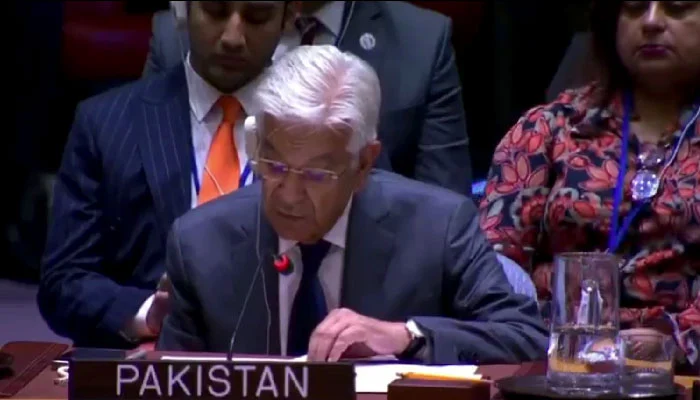

UNITED NATIONS: Defence Minister Khawaja Asif on Wednesday cautioned that the accelerating integration of artificial intelligence (AI) into military systems could make future wars far more dangerous, underscoring the need for urgent international cooperation to prevent an uncontrolled arms race.
Speaking at a high-level debate on AI convened at the United Nations, Asif said that while technological innovation had simplified decision-making processes, it also posed unprecedented risks to global peace and security. “AI has simplified decision-making processes, but it has also created conditions where future wars may be significantly more dangerous,” he warned.
The minister stressed that all states must ensure AI is developed and deployed in line with the UN Charter and in service of humanity. He pointed out that Pakistan had already introduced its first-ever National AI Policy earlier this year, which reflects Islamabad’s commitment to responsible innovation, along with safeguards against misuse.
“The world must adopt collective measures to prevent an uncontrolled arms race in this domain,” he said, adding that “we must ensure AI is harnessed to promote peace and development, not conflict and instability.”
UN Chief’s Call for Global Action
Opening the debate, UN Secretary-General Antonio Guterres echoed similar concerns, stressing that AI is no longer a distant concept but a force rapidly transforming daily life, information systems, and the global economy.
“When used responsibly, AI can strengthen prevention and protection in a myriad of ways — anticipating food insecurity, supporting de-mining, and identifying potential outbreaks of violence,” he said. However, he warned that AI-enabled cyberattacks could cripple critical infrastructure within minutes, while disinformation powered by algorithms posed a growing threat to trust and democracy.
“Innovation must serve humanity — not undermine it,” Guterres emphasised.
The UN chief recalled that the UN General Assembly last month approved the establishment of an Independent International Scientific Panel on AI as well as an annual Global Dialogue on AI Governance to ensure oversight of the technology’s rapid evolution.
Human Control Over Weapons
Guterres stressed that humanity’s fate must never be left to algorithms, insisting that humans must retain authority over life-and-death decisions. He urged member states to preserve human judgment in every use of force and renewed his call for a legally binding ban on lethal autonomous weapons systems operating without human oversight by 2026.
Read More: PM Shehbaz Meets US President Trump at White House
“Similarly, any decision in nuclear weapon use must rest with humans — not machines,” he stressed.
Pakistan’s Position
Concluding his remarks, Khawaja Asif reaffirmed Pakistan’s commitment to supporting all global efforts aimed at balancing technological progress with peace and security. “Pakistan remains committed to supporting international efforts aimed at balancing technological progress with the imperatives of global peace and stability,” he said.
Diplomats present at the debate said the discussion highlighted a growing consensus that while AI holds transformative potential, unchecked militarisation could threaten international stability.
