

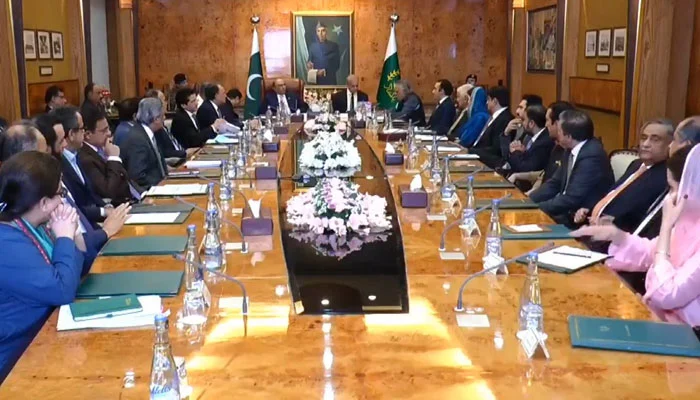

ISLAMABAD: President Asif Ali Zardari has directed state institutions to adopt coordinated measures to reduce the burden of rising energy and essential goods costs on economically vulnerable citizens amid supply pressures linked to Middle East tensions.
The president chaired an expanded consultative meeting at Aiwan-e-Sadr, attended by Prime Minister Shehbaz Sharif, along with leadership from the four provinces, Gilgit-Baltistan and Azad Jammu and Kashmir.
Participants were briefed on steps taken by federal and provincial governments to manage price pressures, ensure availability of essential supplies and mitigate the impact on the public, enabling a coordinated national response, according to a statement issued by the President Secretariat Media Wing.
The meeting also reviewed the broader regional situation and its potential implications for Pakistan’s security environment, economic outlook and food security.
Officials assured the participants that, despite global disruptions, timely decisions had ensured uninterrupted fuel supply and that adequate petroleum stocks were available, with future arrangements also in place.
It was noted that proposals to increase oil prices had been repeatedly rejected, while savings from austerity measures were being redirected towards public relief. The government has also reduced its own expenditure, including cuts to the development budget and the immediate grounding of 60% of official vehicles.
President Zardari emphasised that vulnerable segments of society would not be left alone during the challenging period and called for coordinated decision-making across economic management, energy planning, food security and security preparedness.
He also directed authorities to enhance public awareness campaigns focusing on reducing fuel consumption, promoting public transport use and encouraging shared mobility practices.
The meeting was attended by Deputy Prime Minister Ishaq Dar, Defence Minister Khawaja Asif, Interior Minister Mohsin Naqvi, National Security Adviser Lt Gen Asim Malik, Bilawal Bhutto Zardari, Finance Minister Muhammad Aurangzeb, Petroleum Minister Ali Pervaiz Malik and other senior officials.
The session followed a high-level consultative meeting held last week, also chaired by the president, which included Chief of Army Staff Syed Asim Munir and federal ministers.
At that meeting, the civil-military leadership endorsed a unified policy approach through consensus and institutional coordination to safeguard Pakistan’s security, economy and food supply, with an emphasis on aligning economic, energy and security strategies.
Meanwhile, Pakistan has intensified diplomatic efforts to help reduce regional tensions through broader international engagement.
