

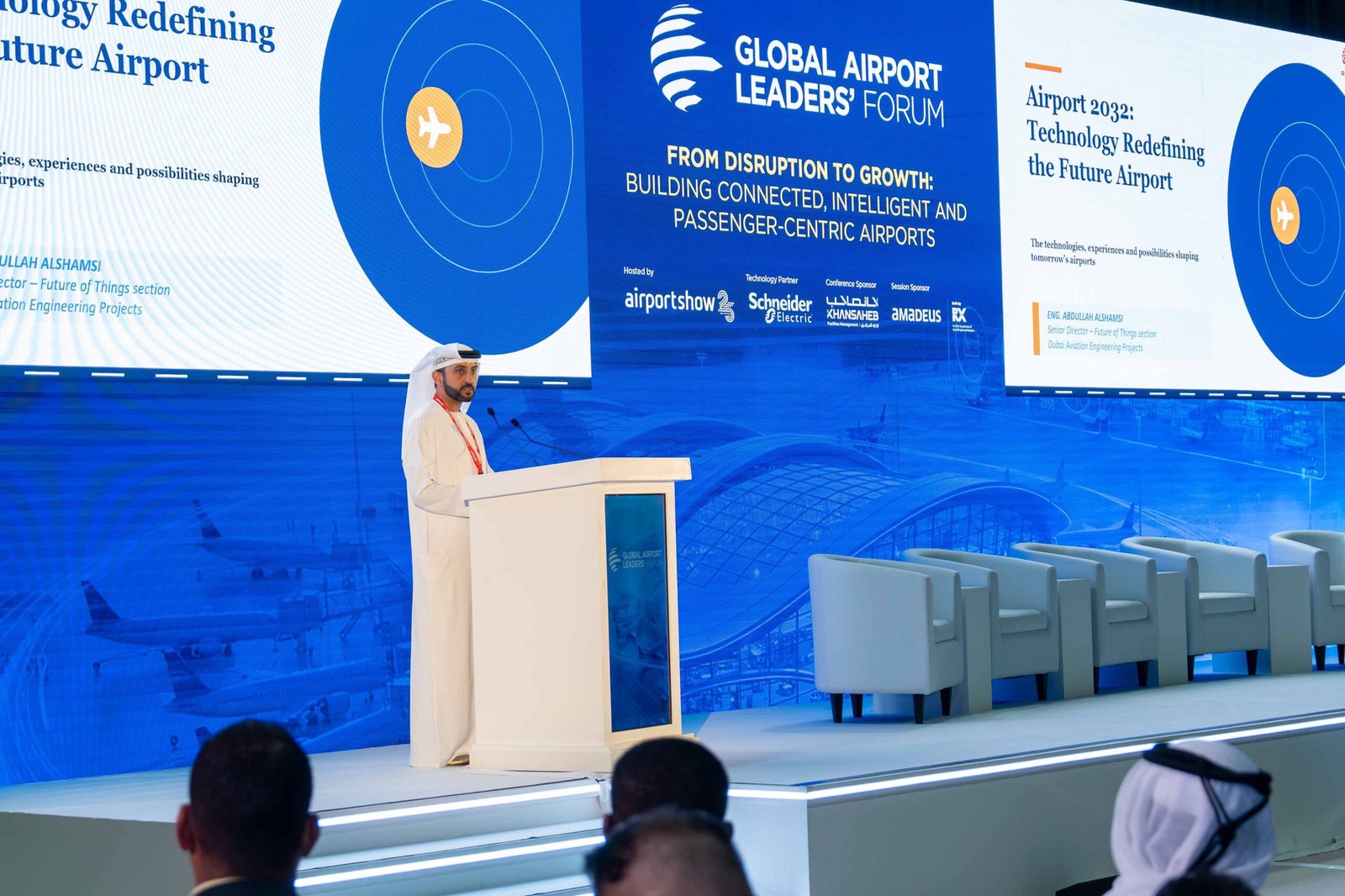

DUBAI: The Global Airport Leaders’ Forum (GALF) has highlighted the future of airport design, infrastructure development and emerging technologies aimed at making air travel smoother, more accessible and more convenient for passengers.
The 13th edition of the forum, held alongside the 25th Airport Show at the Dubai World Trade Centre, brought together government officials, industry experts and representatives of companies operating across the aviation sector to discuss innovation and the future of airport operations.
Khalifa Al Zaffin, executive chairman of Dubai Aviation City Corporation and Dubai South, said Dubai’s ambition to build the world’s largest airport extended beyond infrastructure size and passenger capacity, focusing instead on delivering the best possible passenger experience.
He emphasised the need to design flexible airports capable of accommodating emerging technologies and adapting to future developments in aviation.
In his opening address, Al Zaffin described the Airport Show as an important platform for airport developers and technology providers to exchange expertise, explore operational solutions and experience the latest innovations.
Reflecting on the exhibition’s origins 25 years ago, he said the initiative emerged from the need to bring airport technologies together under one roof, reducing the need for industry professionals to travel to different countries to explore new solutions.
He reaffirmed the corporation’s continued support for the exhibition, noting that rapid technological advancement required airports to remain flexible enough to integrate new systems into their operations over the long term.
Majed Al Joker, chief operating officer of Dubai Airports, identified collaboration, operational resilience and innovation as three key priorities for the future of aviation.
He said passengers experienced an airport journey as one continuous process rather than a series of separate services and procedures. Improving capacity and service standards therefore depended on effective coordination among stakeholders across the airport ecosystem.
Al Joker stressed that collaboration became particularly important during operational disruptions, when effective responses relied on established relationships, clear leadership, teamwork and lessons learned from previous incidents.
He said intelligent systems could help airports anticipate challenges and address them before passengers were affected, adding that technology investments should deliver smoother, more reliable and less complicated journeys.
He also highlighted the importance of preparing the workforce for future demands, saying employees’ expertise, decision-making abilities and commitment to passenger care were essential to translating technological capabilities into tangible improvements.
Abdullah Al Shamsi, senior manager of Future of Things at Dubai Aviation Engineering Projects, outlined a vision for airport innovation by 2032, in which technology operates seamlessly in the background to simplify passenger journeys without adding procedures or complexity.
He said the most advanced airport might not be the one where passengers encounter the most technology, but rather the one where technology is least noticeable.
The approach relies on integrating artificial intelligence, digital identity, biometrics and real-time data analytics to anticipate congestion, optimise resource allocation and provide personalised information and assistance.
Al Shamsi said the needs of business travellers, families with children, transit passengers and People of Determination differed, requiring airports to move away from a one-size-fits-all model towards more personalised services.
As an example, he presented the results of the “City Terminal” pilot project, which aims to redefine traditional airport boundaries by allowing passengers to complete travel formalities at locations within the city.
The trial included check-in, baggage drop-off, security screening and passport control outside the airport, followed by the transfer of passengers in secure vehicles directly to the airport concourse.
According to Al Shamsi, the project reduced the overall journey time from at least 120 minutes to approximately 45 minutes, representing a reduction of around 60%.
He said the results demonstrated that airport procedures could be fundamentally redesigned, challenging traditional assumptions about where the airport journey begins.
Al Shamsi added that the Al Maktoum International Airport project offered an opportunity to rethink airport design and operations from the outset by integrating infrastructure, technology and passenger experience within a unified vision.
He said preparing for the future did not require predicting every technological innovation, but rather creating an airport flexible enough to accommodate new technologies, operating models and evolving passenger expectations.
“Our ambition is not to build an airport with more technology, but an airport that becomes better because of technology,” he said.
Khalid Ibrahim Saif, director of Aviation Economics and Growth at the Dubai Civil Aviation Authority, highlighted the importance of moving beyond managing operational disruptions towards a broader strategy focused on sustainable growth and stronger connectivity.
He said continued growth in air travel required economic expansion to be aligned with infrastructure development and greater operational efficiency.
Saif also stressed the need for closer integration between airports, airlines and regulatory authorities, alongside the use of smart technologies and data to build a more resilient aviation ecosystem.
Such an approach, he said, would strengthen the sector’s competitiveness and improve the overall passenger experience.
