

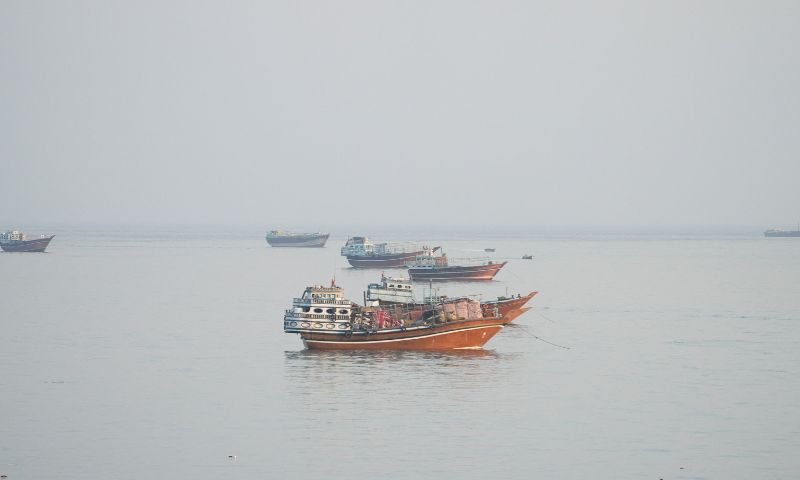

DUBAI: Four oil tankers were hit by explosions in the Strait of Hormuz, Iran’s military said on Thursday, claiming the vessels had ignored warnings and entered areas it considers restricted within the strategic waterway.
Tanker attacks have continued across the strait despite a rebound in maritime traffic and expectations of de-escalation in the conflict between the United States and Iran, which have contributed to a decline in oil prices.
Iran’s Revolutionary Guards Navy said two supertankers were disabled by explosions on Wednesday after ignoring warnings against using what it described as an “unauthorised route”.
Reuters could not immediately verify the Iranian account.
Iranian state media reported that the two vessels had “exploded after hitting naval mines”, broadcasting what it said was video footage of the incidents.
Iran’s army later said two other tankers struck mines on Thursday afternoon while sailing through the eastern Strait of Hormuz. According to state television, the vessels had ignored warnings, disabled their radar systems and entered a restricted area before catching fire.
During the early stages of the US-Israeli war with Iran, which began in February, the Islamic Revolutionary Guard Corps (IRGC) Navy openly announced attacks on tankers. More recently, however, it has reported that vessels caught fire after hitting naval mines while travelling through the southern part of the strait, which Tehran has declared an unauthorised route.
In several such incidents, the United Kingdom Maritime Trade Operations (UKMTO) agency has reported that vessels were struck by unidentified projectiles.
In reports issued on Thursday, UKMTO said a vessel was hit by an unidentified projectile about 14 nautical miles northwest of Ras Al-Khaimah in the United Arab Emirates on Wednesday while exiting the strait. The incident caused a fire in the engine room.
Firefighting operations were under way and all crew members had been evacuated, the agency said.
At least 10 ships were hit during the first 10 days of November, following 37 attacks in October, the highest monthly tally since the conflict began in late February, according to data from the Washington Institute for Near East Policy.
