

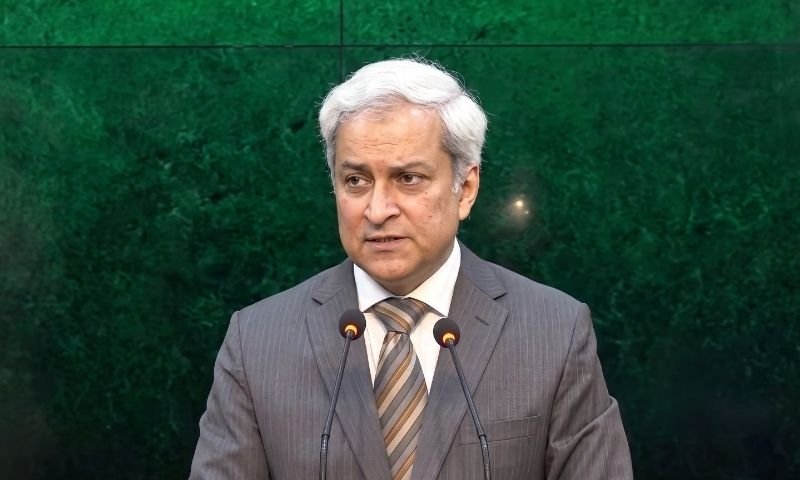

ISLAMABAD: The Foreign Office on Wednesday said India could not walk away from its international legal obligations under the Indus Waters Treaty simply because the outcome did not go in its favour, warning that New Delhi’s conduct was damaging the sanctity of treaties and the broader international dispute-resolution system.
Addressing the weekly press briefing, Foreign Office spokesperson Tahir Hussain Andrabi said India’s behaviour was undermining confidence in established international legal and dispute-resolution mechanisms and could set a dangerous precedent for agreements governing shared resources in other parts of the world.
He said unilateral measures concerning cross-border water management in a sensitive region such as South Asia were extremely concerning and ran counter to sustainable peace and regional stability.
Andrabi said India must fully comply with the Indus Waters Treaty and respect the institutional mechanism established under the agreement, noting that both countries had formally accepted the treaty’s framework.
He said the Indian foreign ministry’s rejection of the Court of Arbitration’s award could not nullify India’s legal obligations.
“India cannot absolve itself of its obligation to implement the Court of Arbitration’s award,” the spokesperson said, adding that rejecting the award would not change India’s responsibilities under the treaty.
Pakistan remains engaged on US-Iran tensions
On growing tensions between the United States and Iran, Andrabi said Pakistan was concerned over the escalation and remained in contact with both countries to encourage a resolution through dialogue.
He said increased tensions were not in anyone’s interest and rejected the notion that the latest escalation represented a failure of Pakistan’s mediation efforts.
Andrabi said Islamabad remained continuously engaged with complete sincerity in efforts to advance the peace process.
He said Prime Minister Shehbaz Sharif had met Iranian President Masoud Pezeshkian, while Deputy Prime Minister and Foreign Minister Ishaq Dar had held important contacts with Iranian Foreign Minister Abbas Araghchi and other regional leaders.
The spokesperson said Chief of Defence Forces Field Marshal Syed Asim Munir’s visit to Tehran last month had strengthened efforts to resolve the Strait of Hormuz dispute.
Pakistan’s diplomatic efforts would continue, Andrabi said, expressing hope that both sides would return to the negotiating table.
He said the Islamabad Agreement and the Pakistan-US joint statement provided a framework for negotiations and urged the parties to pursue political and technical talks for a lasting and sustainable solution.
Pakistan assumes SCO chairmanship
Speaking about Prime Minister Shehbaz Sharif’s visit to Bishkek, Andrabi said the premier met Kyrgyz President Sadyr Japarov, with Pakistan and Kyrgyzstan signing several agreements and memoranda of understanding covering trade, economy, investment and infrastructure.
He said the two leaders discussed various aspects of bilateral relations, while the prime minister and Deputy Prime Minister Ishaq Dar also held meetings with counterparts and world leaders on the sidelines of the Shanghai Cooperation Organisation summit.
Dar separately met the SCO secretary-general and United Nations Secretary-General António Guterres, he added.
Andrabi confirmed that Pakistan had assumed the one-year chairmanship of the SCO and would host next year’s summit under the theme “Turning Vision into Action: Connectivity, Innovation, and Shared Prosperity”.
He said Pakistan would work with SCO member states to promote regional peace and stability, economic cooperation, connectivity, shared development and prosperity.
Makkah defence agreement
The spokesperson said the inaugural session of the Strategic Political and Defence Committee established under the Makkah Joint Defence Agreement was held in Istanbul on August 31.
Pakistan, Saudi Arabia and Türkiye reaffirmed their commitment to regional peace and stability through peaceful resolution of crises, restraint and de-escalation, he said.
The three countries agreed to further institutionalise cooperation under the agreement and strengthen collective defence and shared security.
Andrabi said the agreement’s secretariat would be established in Saudi Arabia, while its secretary-general would initially be appointed from Pakistan for a three-year term.
The three countries would also enhance cooperation in the defence industry, joint technology production and capacity-building of their armed forces, he added.
Dar holds meetings in Türkiye
Andrabi said Dar met Turkish Foreign Minister Hakan Fidan in Istanbul, where both sides welcomed further strengthening of Pakistan-Türkiye relations in political, economic, security and cultural fields.
The two countries agreed to hold the next session of the High-Level Strategic Cooperation Council as soon as possible, potentially within the current year, he said.
They also agreed to maintain close cooperation on regional and global affairs and to promote peace and stability.
Dar also held a meeting with the Turkish defence minister during his visit to Istanbul, the spokesperson added.
New FO spokesperson to assume charge
Andrabi, who is set to be posted to Geneva, also welcomed Ambassador Sajjad Haider Khan as the new Foreign Office spokesperson.
Ambassador Sajjad Haider Khan will lead the ministry’s weekly briefings from next week.
