

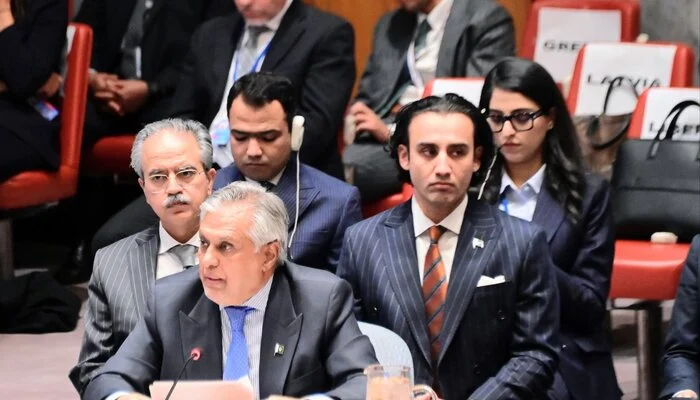

NEW YORK: Deputy Prime Minister and Foreign Minister Ishaq Dar has called for greater international cooperation to ensure artificial intelligence does not become another front in the global arms race, stressing that human judgement and control must remain central to the development and use of AI.
Addressing a UN Security Council briefing on artificial intelligence and international security on Thursday, Dar said AI was rapidly transforming societies, economies and security systems, with its impact particularly visible in international and regional peace and stability.
He described AI as a force multiplier and cross-cutting dual-use technology that was opening a new chapter in modern warfare.
Dar said the foremost priority should be to retain human judgement and control at every stage of AI design, development and integration.
He stressed that humans must remain responsible for defining the structures of AI systems and determining the pace and nature of their future capabilities.
The foreign minister called for guardrails, regulations and governance frameworks to prevent AI from becoming another facet of the ongoing arms race.
In the military domain, he said restraint and confidence-building measures were needed to reduce the risks of miscalculation and compressed decision-making.
Dar also warned against allowing AI to become the monopoly of a small number of countries or companies, saying international collaboration was essential to ensure its development remained representative, transparent and inclusive.
He highlighted misinformation, fake news and cyberattacks, including attacks on critical infrastructure by state and non-state actors, as challenges that were being intensified by AI.
The deputy prime minister cautioned that efforts to regulate the pace of frontier AI should not become a new form of technological gatekeeping.
He said if a few actors were allowed to determine the pace of AI development while others were held back through restrictions, existing technological and economic disparities could deepen, turning a safety agenda into technological exclusion.
“The risks of uncontrolled AI would be borne by all; decisions on how to manage them cannot rest with a handful of companies or capitals,” Dar said.
He stressed the need to avoid fragmentation in AI development and governance, calling for issues surrounding AI development, deployment and broader implications to be addressed through open, representative and inclusive forums with universal participation under UN auspices.
Dar welcomed the first UN Global Dialogue on AI Governance and said Pakistan supported collaborative international efforts to maximise the benefits of AI while addressing its risks.
He highlighted Pakistan’s participation as a founding member of China’s initiative to establish the World Artificial Intelligence Cooperation Organisation (WAICO), describing it as a step towards promoting AI development “for good, and for all”.
The foreign minister also stressed the importance of confidence-building measures to maintain international and regional peace and security, saying practical tools were needed to reduce mistrust, prevent accidental escalation and manage risks associated with military and foundational AI systems.
Dar reaffirmed Pakistan’s commitment to international cooperation on AI and said Islamabad would work with UN member states to bridge the global AI divide and promote equitable access to the technology for peace and development.
His remarks came as the Security Council debated the rapidly expanding security implications of AI, including its potential military applications, autonomous systems and the risks posed by increasingly compressed decision-making.
