

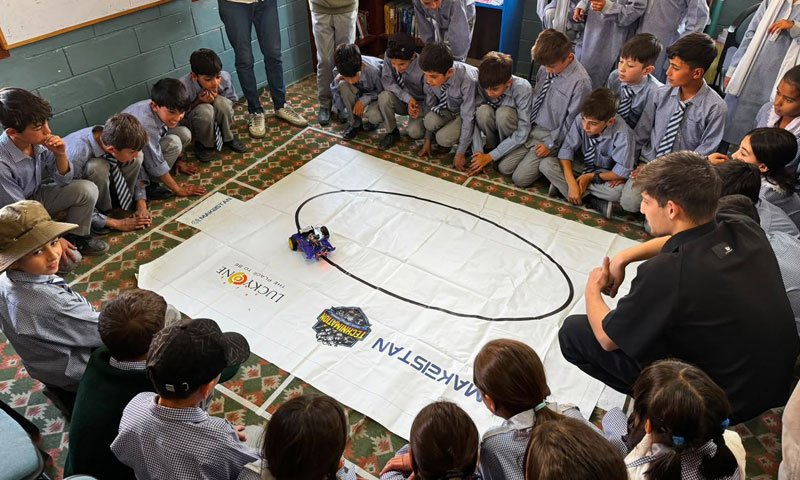

GILGIT: Known for its towering mountains, breathtaking landscapes and natural beauty, Gilgit-Baltistan is also home to a growing pool of young talent with the potential to shape the region’s technological future.
An organisation called Makeistan is working to highlight that potential by encouraging children to move beyond consuming technology for entertainment and use it to create, innovate and address real-world challenges.
At a time when parents are increasingly concerned about children’s dependence on screens, social media and video games, the initiative is offering a hands-on approach to learning. Its young participants are building robots, exploring alternative energy sources, developing drones and discovering how technology can help tackle climate change.
Founded by engineers Ehsam Ullah Baig and Natasha, Makeistan is a makerspace offering practical education in science, technology, engineering and mathematics (STEM), including robotics, coding and artificial intelligence.
The organisation also works with schools and universities through school-based STEM laboratories, teacher training and practical learning programmes.
For 34-year-old Ehsam, the initiative represents a personal commitment to his hometown. After spending nearly a decade working internationally and building things for others, he returned to Gilgit and decided to establish a platform that could help his own community develop technological skills and find local solutions to everyday problems.
He founded Makeistan two years ago with the ambition of demonstrating that even a remote region such as Gilgit-Baltistan could become a centre of innovation and creativity.
“People know Gilgit-Baltistan only for its beauty. I wanted to change that. Also, because it’s remote, there are a lot of problems here. I wanted to create solutions for them here and make a space that makes locals self-sufficient enough to solve them on their own,” he told HUM News English Digital.
What began as a community-driven initiative gradually attracted children and residents interested in learning new skills.
Ehsam said Makeistan had provided free training and learning materials to students and local residents for two years, adding that some of its trainees had now started teaching other children.
“We have trained students who came to our space, free of cost for two years, and locals too. We provided materials to the kids and people who came to learn here and trained them on how to use them. A lot of our trainees are now training other kids out there,” he said.
Making technology accessible
Accessibility remains central to Makeistan’s approach, particularly in a region where many families cannot afford expensive private education and specialised technology courses.
Ehsam said the initiative was helping children acquire skills in emerging technologies without placing an additional financial burden on their parents.
“People here cannot pay 50k in their kids’ school fees. They cannot afford the kind of education offered by institutions like Beaconhouse. This initiative is really helping our kids learn technology without making their parents’ pockets empty. Now we are also conducting training in Islamabad, and we have done a training in Karachi as well,” he said.
Beyond teaching technical skills, Makeistan encourages participants to apply their knowledge to challenges affecting their communities.
Power shortages are one such challenge. Children are exploring cleaner and more sustainable energy sources, learning how technology and locally available resources could help communities reduce their dependence on conventional electricity supplies.
Climate change is another area of focus. Gilgit-Baltistan’s glaciers, rivers and agricultural communities are particularly vulnerable to changing environmental conditions. Farmers also depend on water channels for irrigation, making the monitoring of water flows important for local livelihoods.
To address this need, Makeistan has developed the Kul Flow Monitor with the participation of children.
“At Makeistan, we have built the Kul Flow Monitor with kids. It is a solar-powered, off-grid device that shows channel flow from a distance and is made from parts that you can find in Gilgit,” Ehsam said.
The project demonstrates how technology can be adapted to local requirements using accessible materials, rather than relying entirely on expensive imported equipment or external expertise.
Participants are also exploring drone development, renewable energy and environmental monitoring, while learning how to identify problems, collaborate and develop practical solutions.
Encouraging girls in technology
Makeistan is also working to increase girls’ participation in science and engineering, fields traditionally regarded as male-dominated in many communities.
Ehsam said the organisation was trying to create an inclusive environment where girls could experiment with technology and develop their skills alongside boys.
“My co-founder is a woman, Natasha. There are women working here at Makeistan, and we have a 30/70 ratio of girls to boys. There’s also this taboo that girls should not learn these things, as engineering is considered a men’s field. But things are changing, and we’re hoping more girls will learn to use technology to help build their communities,” he said.
Around 30 per cent of Makeistan’s participants are girls, a proportion the organisation hopes to increase as more families encourage their daughters to pursue technology and engineering.
Ultimately, Makeistan is seeking to change perceptions about both Gilgit-Baltistan and the potential of its young people.
While the region is widely recognised as a tourist destination because of its mountains, lakes and natural landscapes, the initiative wants its people to be recognised for their creativity, technical abilities and capacity to innovate.
Its work also highlights that innovation does not necessarily require a major city or an expensive laboratory. With access to practical learning, basic resources and an environment that encourages experimentation, young people can begin developing solutions to problems in their own communities.
In a region celebrated for its towering mountains, Makeistan is nurturing another valuable resource: the ideas and ingenuity of its children.
