

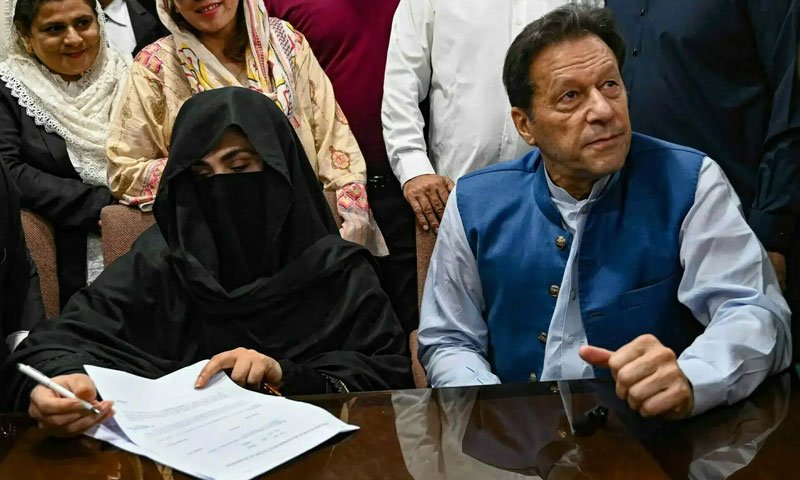

ISLAMABAD: Barrister Salman Safdar, counsel for former prime minister and Pakistan Tehreek-e-Insaf (PTI) founder Imran Khan and his wife Bushra Bibi, on Wednesday argued before the Islamabad High Court (IHC) that the £190 million Al-Qadir Trust case caused no loss to the national exchequer, claiming the recovered funds had doubled through investment while remaining in the Supreme Court’s account.
Opposing the couple’s convictions, Safdar told the court that only £171 million had actually been transferred to Pakistan and that the amount remained in the Supreme Court registrar’s account for four years, generating profits through investment.
“Where is the loss?” he asked, arguing that the money, the land and the Al-Qadir Trust all continued to exist and that the transaction had caused no financial loss to the national exchequer.
Safdar maintained that the £171 million transferred from Britain had been deposited in the Supreme Court registrar’s account, where it remained for four years and generated returns.
“The money doubled through the Supreme Court’s investment,” he said, questioning how the transaction could be treated as a loss to the national exchequer.
“If the money was wrong, it would not have remained in the Supreme Court’s account for four years,” he argued, challenging the classification of the funds as proceeds of crime.
The lawyer also disputed the £190 million figure, saying only £171 million had reached Pakistan and accusing the media of incorrectly reporting the amount.
Explaining the transaction, Safdar said the funds were transferred to the Supreme Court registrar’s account instead of the State Bank of Pakistan (SBP). He said the account had been opened for the payment of a Rs460 billion fine imposed on property developer Malik Riaz.
According to the lawyer, a note for the return of the money was prepared on December 2, 2019, and approved by the federal cabinet the following day. However, the prosecution has alleged that a confidential deed was signed on November 6, 2019, before the cabinet’s approval.
Safdar said the National Accountability Bureau (NAB) alleged that former accountability adviser Mirza Shahzad Akbar had sent the summary to then prime minister Imran Khan, which was subsequently approved by the cabinet, and had signed the confidential deed with Britain’s National Crime Agency (NCA).
He said NAB’s objection was not that the £171 million had been transferred to Imran Khan or Bushra Bibi’s personal accounts, but that the amount had been deposited with the Supreme Court registrar instead of the central bank.
The lawyer also questioned NAB’s understanding of the frozen funds, arguing that the bureau did not know which accounts held the money or when and why it had been frozen.
Turning to the land transferred to the Al-Qadir Trust, Safdar said it had been donated in April 2019, before legal proceedings against the property developer began in Britain in August of that year.
He told the court that Bahria Town had donated 458 kanals of land to the trust through Zulfiqar Abbas Bukhari, also known as Zulfi Bukhari, a close aide of Imran Khan. The land was initially transferred to Bukhari and subsequently to the trust, rather than directly to the former prime minister, he added.
“Malik Riaz had donated the land before proceedings against him began in Britain,” Safdar argued, saying the sequence of events contradicted the prosecution’s allegation of a bribe.
He maintained that the proceedings in Britain were civil rather than criminal and challenged NAB to establish how the recovered money constituted proceeds of crime.
Safdar also disputed NAB’s description of the Al-Qadir Trust as a fictitious entity, saying it was an operational educational institution where more than 150 students were receiving scholarships.
He said the trust had been declared bogus and its property confiscated despite functioning as an educational institution. Money provided by Riaz for the construction and furnishing of its building had also been transferred to the trust’s account, not Imran Khan’s personal account, he added.
The lawyer said the trust had been established on barren land in Sohawa, questioning why anyone intending to receive a bribe would choose such a location instead of prime land.
He further questioned the charges against the couple, arguing that the reference did not specify the financial benefit allegedly obtained by Imran Khan or explain Bushra Bibi’s precise role in the alleged offence.
Describing the reference and charge sheet as ambiguous, Safdar said documentary evidence of the alleged illegal transactions had not been presented.
He also pointed out that six accused, including Malik Riaz, Shahzad Akbar, Farhat Shahzadi, also known as Farah Gogi, and Zulfi Bukhari, had remained absent during the trial, while proceedings continued against Imran Khan and Bushra Bibi.
Safdar said Imran Khan was arrested in the case on November 13, 2023, and remained in custody until the verdict. The former prime minister was sentenced to 14 years in prison and fined Rs1 million, while Bushra Bibi received a seven-year prison sentence and a Rs500,000 fine for abetment.
He added that Bushra Bibi had never been arrested during the trial and that NAB had not taken her into custody.
At the outset of the hearing, Safdar sought permission to argue in support of a request filed by Imran Khan’s legal team for live-streaming the appeals’ proceedings.
He said the case was of national and international importance and argued that modern technology could be used to broadcast the proceedings, as had been done by the Supreme Court.
However, IHC Chief Justice Sardar Muhammad Sarfraz Dogar, heading a division bench with Justice Muhammad Asif, said he had already rejected the request at the previous hearing and that the matter was pending before the relevant committee.
Justice Dogar said the IHC was an independent institution and was not bound to follow the Supreme Court’s rules and procedures.
When Safdar referred to Imran Khan as a 74-year-old former prime minister, the chief justice remarked: “You should have this written in golden words that he is a former prime minister.”
The lawyer later requested the court to defer the appeals until rules for live-streaming were framed.
“You cannot dictate to me. Start your arguments; what should and should not happen in court is my responsibility,” the chief justice responded.
During the hearing, NAB prosecutor Javed Arshad also objected to some of Safdar’s arguments, describing them as political statements rather than legal submissions.
The court adjourned further proceedings until next week.
The Al-Qadir Trust case concerns allegations of corruption and misuse of authority involving £190 million recovered by Britain’s National Crime Agency and returned to Pakistan during Imran Khan’s tenure as prime minister.
NAB alleged that Imran Khan and Bushra Bibi facilitated an arrangement involving the returned funds in exchange for land and other benefits from a property developer.
An accountability court convicted the couple on January 17, 2025, sentencing Imran Khan to 14 years in prison and Bushra Bibi to seven years.
Both have denied the allegations and challenged their convictions before the Islamabad High Court.
