

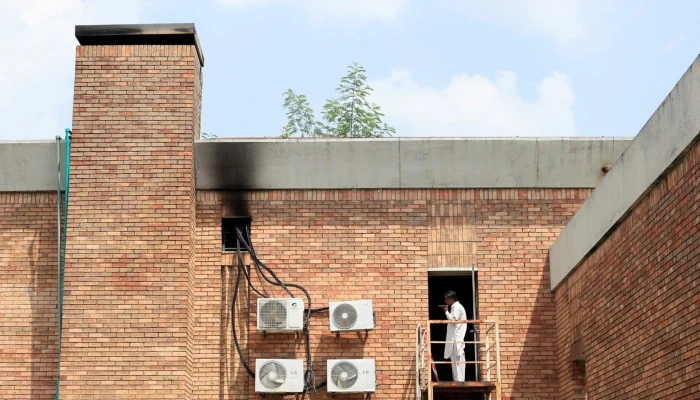

ISLAMABAD: An interim inquiry report into the deadly fire at the Pakistan Institute of Medical Sciences (PIMS) that claimed the lives of 14 newborns has found that the precise source of ignition remains technically unresolved, while clearing frontline clinical staff of abandoning the infants.
The four-member inquiry committee, constituted to investigate the August 26 fire at the PIMS gynaecology ward, said CCTV footage showed that immediate rescue attempts were made after the fire became visibly apparent at around 6:38am.
“The objective CCTV evidence does not support a generalised finding that frontline clinical staff abandoned the newborns,” the report stated.
According to the report, the fire developed with extraordinary rapidity, with the nursery becoming substantially engulfed in smoke within approximately two minutes.
The committee said the exact source of ignition could not be conclusively established. An internal electrical or equipment-related origin remained plausible, but available evidence did not determine whether the fire started from an incubator, warmer, air conditioner, plug, socket, wiring or another component.
The inquiry, however, identified serious institutional shortcomings in fire and life-safety preparedness, emergency exits and access, emergency notification, evacuation planning, firefighting arrangements and security coordination.
The committee noted that these shortcomings were particularly significant because PIMS had experienced another fire at its nursing hostel in July 2026, around seven weeks before the neonatal ward incident. Similar deficiencies in institutional safeguards had already been identified following that incident.
The report also identified shortcomings in the staffing of the Neonatal Intensive Care Unit, saying fewer staff than required under the duty roster were present when the fire broke out.
It held Head of Department Neonatology Professor Dr Sadia Riaz responsible for ensuring the presence of doctors and allied staff at their assigned duties.
The committee recommended the immediate suspension of Professor Dr Sadia Riaz and Senior Registrar Dr Nagham for allegedly failing to ensure the presence of qualified healthcare professionals and for being absent from duty at the relevant time.
The inquiry also held the hospital administration responsible for failing to take adequate measures after the July fire at the PIMS nursing hostel.
It said the administration should have conducted fire-safety drills, ensured the integrity of firefighting equipment and developed detailed standard operating procedures and incident-handling mechanisms.
The committee recommended the immediate suspension of Executive Director PIMS Professor Dr Imran Sikandar, Joint Executive Director MCH Dr Mutahir Shah, Joint Executive Director Non-Medical PIMS Ch Waris Ali Raza and Director MCH Dr Nosheela Amjad, with proceedings against them under the E&D Rules 2020.
The report also criticised the Capital Emergency Service (CES), saying the organisation responsible for fire safety in Islamabad, including at PIMS, failed to address systemic shortcomings after the July fire.
The committee recommended the immediate suspension of CES CDA Islamabad Director General Dr Abdul Rehman and PIMS Assistant Director Security Muhammad Usman over alleged absence from duty without leave and dereliction of duty.
The committee further recommended action against Belfort Security under relevant laws through PIMS for allegedly failing to fulfil its contractual obligations.
Regarding possible criminal liability, the inquiry said allegations concerning locked or obstructed mandatory fire exits, failure to address previously identified life-safety deficiencies and any established delay in summoning external emergency services should be referred for criminal investigation if the evidence establishes the ingredients of a cognizable offence.
It clarified that final determination of criminal responsibility would rest with the competent investigating and judicial authorities.
The committee said the broader institutional lesson was more important than identifying a single defective appliance or individual responder, noting that while the precise cause of the first spark remained unresolved, accountability could not be limited to the point of ignition.
The report called for three separate forms of action — departmental proceedings where assigned public duties were prima facie neglected, contractual action where outsourced obligations were breached, and criminal investigation where a culpable omission affecting life safety may have materially contributed to the deaths.
