

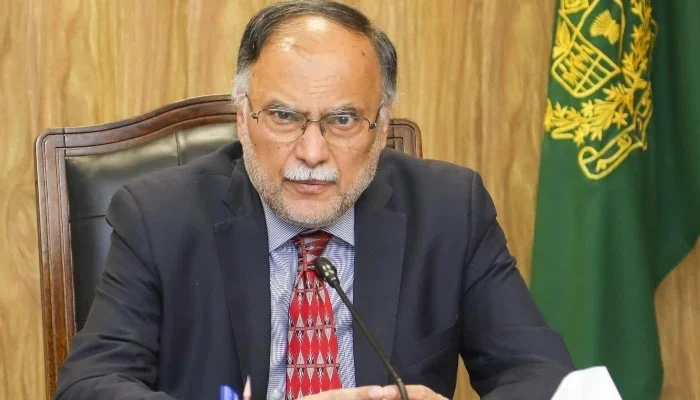

ISLAMABAD: Planning and Development Minister Ahsan Iqbal has proposed the creation of 12 to 15 new provinces in Pakistan, urging Prime Minister Shehbaz Sharif to constitute a committee to examine the country’s administrative structure and initiate a national debate on reforms.
“I have proposed that a committee be made, on administrative reforms, through the law minister that can at least start a national and political debate on what can and cannot be done,” Iqbal told The News.
He said the creation of new provinces would ultimately require broad political consensus and added that he was waiting for Prime Minister Shehbaz to return from Kyrgyzstan before taking up the matter with him.
Iqbal’s proposal comes as the decades-old debate over Pakistan’s provincial structure has resurfaced following recent statements by senior government and military officials in favour of reconsidering the existing administrative setup.
Interior Minister Mohsin Naqvi raised the issue in July, while Inter-Services Public Relations (ISPR) Director General Lt Gen Ahmed Sharif Chaudhry called for a serious debate on the matter a day later.
Iqbal said Pakistan’s four provinces had become increasingly centralised and monopolistic over the years, contributing to shortcomings in the delivery of essential public services, including health and education.
“I would say we need 12-15 new provinces,” he said, suggesting that each of the four provinces could potentially be divided into three.
However, he stressed that any restructuring would have to follow an equitable formula to avoid significantly altering political representation.
“If Punjab is divided into three provinces its share will increase in the Senate,” Iqbal said, adding that the creation of new provinces should be based on a formula that maintains an equitable distribution of representation.
No formal federal process yet
Despite Iqbal’s proposal, there is currently no formal federal process under way for creating new provinces or administrative units.
Rana Ihsaan Afzal Khan, coordinator to the prime minister, told The News that no decision had been taken on the matter.
“No such committee has been made at the federal level. There is no such talk on any forum officially,” he said.
He added that even if new provinces were eventually created, they would be established for the next election cycle.
An old debate returns
Pakistan currently has four provinces, two autonomous territories and one federal capital territory. Political parties and regional groups have periodically demanded additional provinces for decades.
The latest debate intensified on July 30 when Interior Minister Mohsin Naqvi argued that the existing governance structure was no longer working effectively.
During a televised address in Islamabad, Naqvi said the country’s governance system had collapsed and argued that Pakistan had been operating under the same structure for more than 70 years.
He proposed the creation of new administrative units or provinces to address governance challenges.
A day later, the ISPR director general also called for a serious discussion on the proposal.
“If the population has increased by fourfold and you still have four provinces then we have to see if this is serving good governance,” he said while speaking to reporters.
The remarks triggered strong reactions, particularly in Sindh, where nationalist parties have historically opposed proposals to divide the province.
Since August 12, nationalist groups have held near-daily demonstrations and launched campaigns against any attempt to split Sindh.
“We want one Sindh,” Qaumi Awami Tehreek President Ayaz Latif Palijo told The News.
Opposition has also emerged from within mainstream political circles.
Punjab Information Minister Azma Bokhari described Naqvi’s remarks as an unserious approach to a serious issue.
Pakistan Peoples Party leader Nisar Khuhro also strongly opposed the proposal during a recent Sindh Assembly session, declaring that Sindh’s territorial integrity could not be compromised.
Smaller provinces, better governance?
The idea of creating smaller provinces is not new. Proposals for carving South Punjab out of Punjab and creating a Hazara province from Khyber Pakhtunkhwa have been under discussion for decades.
In 2020, the then government established a South Punjab civil secretariat in Multan, a move widely viewed as a possible precursor to the creation of a province comprising the Multan, Bahawalpur and Dera Ghazi Khan divisions.
However, questions remain over whether smaller administrative units would necessarily result in better governance.
Umair Javed, who teaches politics and sociology at the Lahore University of Management Sciences, said academic research on the relationship between the size of administrative units and governance remained inconclusive, although there was some evidence that smaller units could bring decision-making closer to citizens.
He cautioned that decentralisation without effective accountability could instead strengthen local elites.
“It is not just about governance that has been devolved, it is also about governance that is increasing accountability,” Javed told The News. “In the absence of accountability, devolved governance can lead to elite capture.”
The debate therefore extends beyond the number of provinces to the broader question of where political, administrative and financial authority should be concentrated.
Last month, Defence Minister Khawaja Asif proposed placing Karachi in Sindh and Gwadar in Balochistan under federal control rather than creating them as separate provinces.
Javed criticised the proposal, arguing that it could primarily benefit the federal government financially without necessarily improving municipal governance.
He said the federal government lacked both the mandate and capacity to effectively manage governance at the municipal level.
The price of a new map
Even if political consensus were achieved, creating new provinces would involve significant financial and administrative costs.
Pakistan’s fiscal space remains constrained, with the country continuing to face high debt, inflationary pressures and weak economic growth after narrowly avoiding a sovereign default in 2023.
Every new province would require the creation or expansion of major institutions, including a chief minister’s office, provincial assembly, high court and government departments.
Additional administrative structures, bureaucratic positions, salaries and infrastructure would also be required.
Javed said replicating provincial governing structures across new administrative units could impose a substantial financial burden on the country.
Redrawing the administrative map would also raise difficult questions concerning the distribution of water, land, natural resources and federal funds.
Water allocation could prove particularly contentious as the four provinces currently have established shares under the 1991 Water Apportionment Accord.
Any division of an existing province would therefore require agreement on how its water allocation and other resources would be distributed among successor provinces.
Who gains?
Critics argue that the debate is not solely about administrative efficiency but also concerns the distribution of political power and economic resources.
Dr Sorath Sindhu, a political activist in Karachi, said similar proposals had surfaced repeatedly in Pakistan’s political history, particularly during periods of military rule.
She argued that the current debate could represent another attempt to reshape existing political power structures.
Javed said the debate could also weaken the position of major political parties by forcing them to negotiate over territorial and administrative arrangements.
“This conflict in some ways plays into the hands of the establishment,” he said, arguing that the debate could allow powerful institutions to influence the terms of political negotiations.
The proposal for new provinces has therefore reopened a complex national debate involving governance, political representation, constitutional reform, financial resources and provincial identities — with any final decision likely to require broad political consensus.
