


WEB DESK: The United States has imposed a fresh round of sanctions on individuals and organisations accused of helping Iran procure weapons through an international network, as military tensions between Washington and Tehran continue to escalate.
According to the US Treasury Department, the sanctions target Iranian and Russian nationals, along with entities based in Iran, Russia and Nigeria allegedly involved in supporting Tehran’s weapons acquisition efforts.
The Treasury said the sanctioned individuals and organisations facilitated the Islamic Revolutionary Guard Corps (IRGC) through foreign aviation and transport companies, financial channels and travel coordinators to conceal its role in illicit procurement and move personnel and equipment internationally.
The latest measures come amid heightened tensions following recent hostilities over the Strait of Hormuz and form part of the Trump administration’s broader campaign to increase pressure on Iran through economic sanctions.
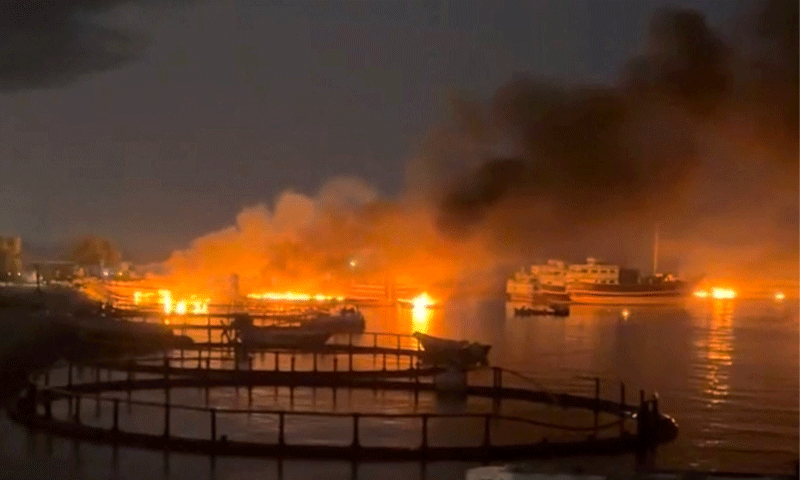
The sanctions coincided with a fresh wave of US military strikes targeting Iran’s military infrastructure. According to US Central Command (CENTCOM), American forces launched coordinated attacks on Iran’s coastal defence systems, cruise missile storage facilities and launch sites on Greater Tunb Island early Wednesday.
CENTCOM said the operation, which lasted around 90 minutes, was aimed at degrading Iran’s ability to threaten commercial shipping in the Strait of Hormuz. The strikes followed a seven-hour operation conducted a day earlier against dozens of Iranian military targets near the strategic waterway.
Iranian state media did not immediately report the attacks.
In response, Iran’s Islamic Revolutionary Guard Corps claimed it had targeted US military installations in Bahrain, Kuwait and Jordan. The IRGC also warned that Iran could disrupt additional regional energy export routes, declaring that the Strait of Hormuz would remain closed until what it described as “the end of America’s evils.”
The conflict has intensified since Iran announced the closure of the Strait of Hormuz, a strategic maritime corridor that previously carried nearly one-fifth of global oil and gas shipments. The United States has accused Iran of attacking seven commercial vessels over the past week, leaving several crew members dead, missing or injured.
Oil prices extended gains by about one per cent on Wednesday after reaching a one-month high a day earlier, reflecting market concerns over continued disruptions to global energy supplies.
Although an interim ceasefire agreement signed last month was intended to pave the way for further negotiations on Iran’s nuclear programme and a permanent truce, diplomatic efforts have stalled amid the renewed military confrontation.
US President Donald Trump warned that Washington would intensify military action if Tehran refused to resume negotiations, saying the United States could target Iran’s energy infrastructure if diplomacy failed.
“I’ll save the energy targets for last, but ultimately we’ll hit energy targets,” Trump said, adding that US officials had urged Iran to return to the negotiating table.
Analysts believe both sides are unlikely to return to full-scale war but caution that the risk of further escalation remains high, particularly if the conflict expands to other strategic waterways, including the Bab el-Mandeb Strait.
Iranian government spokesperson Fatemeh Mohajerani said at least 30 civilians had been killed in recent US strikes in southern Iran, while Iran’s military confirmed seven soldiers were killed in overnight attacks on the Bampur military base.
