

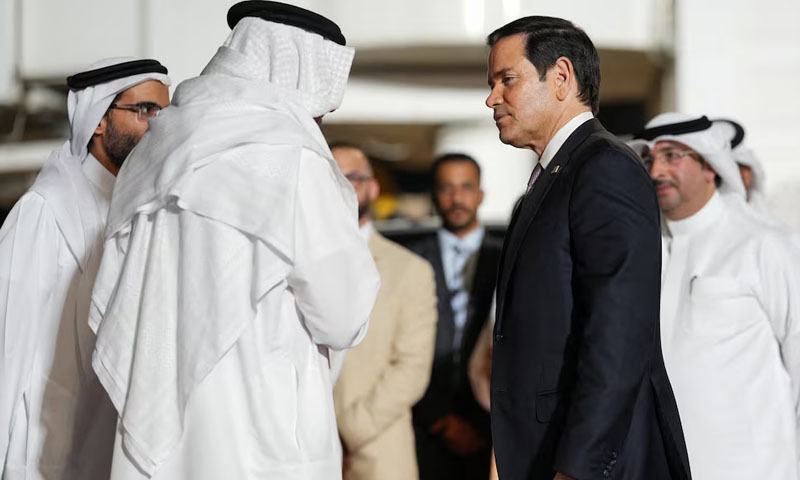

MANAMA: US Secretary of State Marco Rubio on Thursday rejected Iran’s proposal to impose transit fees on commercial vessels passing through the Strait of Hormuz, saying the strategic waterway is an international passage that does not belong to any single country.
Speaking to reporters in Bahrain at the conclusion of a three-day Middle East tour, Rubio said the United States would not accept any attempt to restrict freedom of navigation through the vital global energy corridor.
“The US president’s position on the Strait of Hormuz is clear,” Rubio said, adding that Washington expected Iran to fully honour its commitments under the preliminary maritime understandings reached during recent diplomatic engagements.
He also said Oman had confirmed that no transit fees would be imposed on vessels using the strait and noted that Gulf Arab countries had not supported Tehran’s proposal.
Rubio said the United States remained ready to pursue a broader agreement with Iran, provided Tehran fulfilled its commitments.
“If Iran wants a good deal, the United States is ready, but we expect Tehran to fulfil its promises,” he said.
The secretary of state said discussions with Gulf Cooperation Council (GCC) leaders focused on regional security, stability and strengthening cooperation, adding that no talks were held on financial contributions towards any proposed reconstruction fund for Iran.
He also said negotiations aimed at securing a lasting ceasefire between Israel and Lebanon had entered their third consecutive day with continued US support.
During the briefing, Rubio announced that the United States had dispatched specialised search, rescue and humanitarian teams to Venezuela following two devastating earthquakes that left more than 160 people dead and hundreds injured.
He also confirmed that US President Donald Trump would attend the upcoming NATO summit and described Washington’s relations with Italy as strong.
Rubio’s visit to Bahrain, home to the US Navy’s Fifth Fleet, concluded a regional tour that also included Kuwait and the United Arab Emirates. The trip was aimed at reassuring Gulf allies over Washington’s diplomatic engagement with Iran.
He acknowledged concerns among Gulf states about Iran’s ballistic missile programme and regional influence but stressed that the United States remained committed to the security of its long-standing partners.
“Our meetings with Gulf leaders were highly positive and focused extensively on mutual cooperation and regional stability,” Rubio said. “We are not going to do anything that undermines the security of our long-standing allies in this region.”
He said Washington’s long-term objective remained achieving lasting regional stability while maintaining that any future normalisation with Iran would depend on Tehran’s full compliance with international maritime obligations.
