

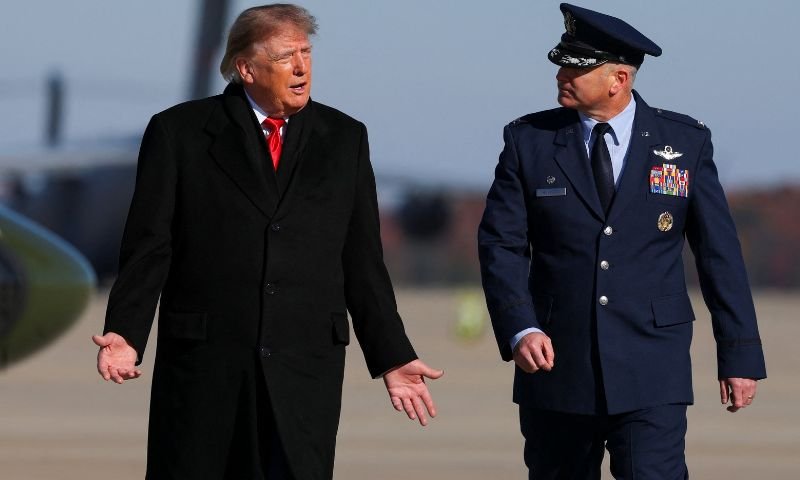

WASHINGTON: The United States on Monday announced fresh restrictions aimed at preventing China from accessing advanced artificial intelligence (AI) chips through overseas data centres, as President Donald Trump travelled to Asia ahead of a meeting with Chinese President Xi Jinping.
The new measures tighten controls on exports of advanced chips manufactured by companies such as Nvidia to data centres in third countries, including Malaysia and Thailand. Chinese companies have used facilities in these countries to remotely access powerful processors for training their AI models.
Under the restrictions, companies in Singapore, Thailand, Malaysia, Indonesia and Brazil will also be required to obtain US export licences for advanced chips, with the Commerce Department citing an increased risk of the technology being diverted to China.
The announcement comes ahead of Trump’s planned meeting with Xi on Thursday in Shenzhen, which is hosting this week’s Asia-Pacific Economic Cooperation (APEC) summit. It also follows criticism of the Commerce Department’s handling of restrictions on China’s access to sensitive American technology.
According to Reuters, the new rules are intended to close loopholes that have allowed Chinese companies to bypass export controls by remotely accessing advanced chips through data centres located in other countries.
“The rule is designed to ensure that existing restrictions on access to sensitive American technology cannot be circumvented through remote computing arrangements involving data centres in third countries,” the Commerce Department said in a statement.
The department said the rules had been drafted by the Treasury Department and the National Security Council, which also directed their release.
The restrictions will not apply to systems used by online retailers and social media companies, as the department said these services do not pose comparable national security risks.
The new measures also formally rescind a Biden-era regulation that sought to restrict global access to advanced AI chips through a licensing system. The Commerce Department announced in early 2025 that it would not enforce the regulation and intended to replace it, but Monday’s announcement marked its formal withdrawal.
The delay had allowed restricted Nvidia chips to reach data centres used by Chinese AI companies, Reuters reported.
Nvidia controversy puts Lutnick under pressure
The announcement comes amid growing scrutiny of Commerce Secretary Howard Lutnick over the administration’s handling of advanced chip exports to China.
Lutnick, who is accompanying Trump on his Asia trip, has faced pressure following the reported resignation of Nvidia chief executive Jensen Huang last week amid revelations about an alleged extramarital relationship involving Alice Huang, a Chinese national suspected of being a spy. The two are not related.
Trump, however, expressed confidence in Lutnick on Monday and said he had no plans to replace the commerce secretary.
“He is doing a very good job,” Trump told reporters as he departed the White House. Asked whether he still had confidence in Lutnick, he replied: “Yeah, I do.”
Trump also said he would not object to Huang returning as Nvidia’s chief executive, adding his support to calls for the former executive’s reinstatement.
“I would certainly not mind seeing that,” Trump said. “He could return. There’s a big group of people that would like him to return.”
The Financial Times reported on Sunday that Huang was considering a comeback and had discussed the possibility with confidants.
A petition calling for his reinstatement had attracted more than 177,000 signatures, according to the website hosting it. Supporters listed included SpaceX and Tesla chief executive Elon Musk, Replit chief executive Amjad Masad and Epic Games chief executive Tim Sweeney.
Trump said he believed Huang had “learned a big lesson” and rejected suggestions that his relationship with the Nvidia executive had put US national security at risk.
“It was not put at risk, and our country is now stronger than ever before,” Trump said, adding that both China and the United States engaged in strategic manoeuvring against each other.
Asked about allegations that Alice Huang was a Chinese spy, Trump said he did not know whether they were true and would investigate the matter. He also suggested the issue could be raised during his meeting with Xi.
The controversy has added to pressure on Lutnick, with senior White House officials discussing whether he should be removed from his position, Reuters reported last week.
Trump’s defence of the commerce secretary and his comments about Huang came as Washington sought to demonstrate a tougher approach to China’s access to advanced American technology ahead of the high-stakes meeting between the two leaders.
