

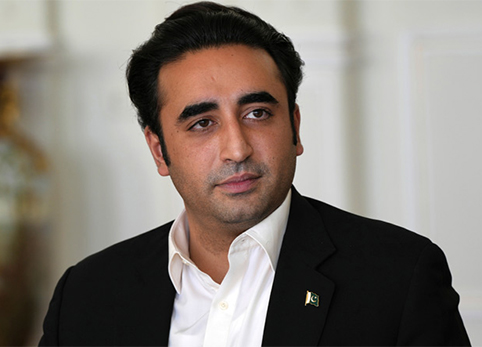

ISLAMABAD: Pakistan Peoples Party (PPP) Chairman Bilawal Bhutto Zardari has defended his right to question the proposed political reset, saying he is a stakeholder in the country’s governance system and must have a say in decisions about its future.
In an interview with HUM News programme Faisla Aap Ka, hosted by Asma Shirazi, Bilawal said the debate over governance reforms could not exclude him or other political stakeholders. It was his first interview with a Pakistani television channel since his press conference in Karachi on Tuesday.
He said the reaction to his remarks suggested that his critics were unwilling to listen to uncomfortable truths.
“I spoke a little too much truth yesterday, and they are finding it difficult to digest,” he said.
“If someone says the system has collapsed, I also have the right to put forward my position. If the system has collapsed, why has it happened? And if someone says it needs a reset, should that be a political or a non-political reset?” he asked.
Bilawal said neither he nor President Asif Ali Zardari had been consulted about the proposed changes. He also questioned whether Interior Minister Mohsin Naqvi, who is also chairman of the Pakistan Cricket Board (PCB), had the authority to determine how the country’s governance system should be reformed.
His remarks followed Tuesday’s press conference in Karachi, where he criticised proposals to create new provinces through a referendum and warned against any attempt to divide Sindh without the consent of its people.
Referring to Naqvi’s proposal for a referendum on creating new administrative units, Bilawal said: “In our history, a referendum has always been carried out for an undemocratic act and never a democratic one.”
He rejected the assertion that the governance system had collapsed, arguing instead that it had been “made to collapse”, in an apparent response to Naqvi’s earlier remarks that the existing system had failed and required a reset.
Bilawal warned that any attempt to divide Sindh by force could trigger serious unrest, saying he was raising an alarm rather than issuing a threat. Recalling the province’s political history during the 1980s and 1990s, he cautioned against imposing decisions without public consent.
“If something is imposed by force, there will be such a fire in this province that it will be difficult to put out,” he said, adding that bloodshed would further damage the country’s economic situation.
He argued that the Constitution already provided a mechanism for creating new provinces and questioned the need to spend public money on what he described as a “fake referendum”.
Challenging the Pakistan Muslim League-Nawaz (PML-N), he suggested that the party should seek a vote in the Punjab Assembly instead of holding a referendum, proposing that the provincial assembly speaker ask members to express their views.
Bilawal also rejected the suggestion that a referendum could be used to convert a decision into a constitutional amendment through a court ruling.
“If such a process were possible, there would have been no need for the 26th and 27th constitutional amendments,” he said.
Returning to the broader governance debate, the PPP chairman said political criticism should not be treated as hostility or grounds for punitive action. Referring to criticism of the government by Jamiat Ulema-e-Islam-Fazl chief Maulana Fazlur Rehman, he questioned whether political disagreement should invite retaliation.
He described the establishment of the Federal Constitutional Court under the 27th Amendment as a historic achievement, clarifying that he was not demanding the reversal of the amendment or the abolition of constitutional courts.
On the opposition’s demands, Bilawal said he could not accept the assertion that every prime minister of Pakistan was corrupt. He expressed the hope that a prime minister would one day complete his tenure without going to jail, adding that Pakistan Tehreek-e-Insaf (PTI) founder Imran Khan was both a politician and a prisoner.
Defending the PPP’s position in the ruling coalition, Bilawal said his party was supporting Prime Minister Shehbaz Sharif in the national interest despite having little interest in sitting on the government benches.
“I still want Shehbaz Sharif to succeed,” he said, acknowledging that supporting the government came with political costs for his party.
He maintained that his proposals to address the country’s political and governance challenges deserved consideration, even if other parties disagreed with them.
“You may disagree with my suggestions, but at least listen. You should have the courage to listen to the truth,” he said.
Bilawal also criticised the decision to discuss proposed changes outside parliament, saying the debate had instead been taken to business leaders and conducted through what he called “touts”. He argued that Pakistan’s society was strong enough to accommodate differing opinions and should not be limited to one-sided discussions.
Recalling his party’s political history, he said the PPP had suffered grave injustices but had never resorted to threats.
“History has dealt us the greatest injustices, but we never issued threats. The cemetery at Garhi Khuda Bakhsh Bhutto tells the story of our sacrifices,” he said.
He further questioned the government’s approach to creating new provinces, insisting that his objections to the process should not be dismissed. He also cautioned against declaring political decisions final without consultation, saying such announcements could have repercussions.
“If someone says the decision has been made, there will be repercussions,” he said, questioning why political decisions continued to produce aftershocks despite the concentration of power.
Earlier, Defence Minister Khawaja Asif responded to Bilawal’s criticism of the political system, saying those demanding equity must first ensure they have “clean hands”.
“If someone claims equity, he must come with clean hands,” Asif said in a post on social media platform X, amid differences between the coalition partners, the PML-N and PPP.
Information Minister Attaullah Tarar also responded to Bilawal’s warning over the possible division of Sindh, reminding him that both parties were part of the same coalition government.
“We are part of the same government. Come and sit down so we can make decisions for the betterment of the people and the country,” Tarar said.
Tarar argued that political parties which had been part of the governing system for decades could not distance themselves from its shortcomings. Defending the proposed referendum, he said the public should be allowed to express its views on the creation of new provinces.
“The people are the ultimate decision-makers. If the people of Pakistan and Sindh want more provinces, then make them; otherwise, don’t,” he said.
The exchange has exposed differences within the ruling coalition over proposed administrative reforms, with Bilawal opposing a referendum and warning against imposing changes on Sindh, while government representatives have called for public consultation.
