

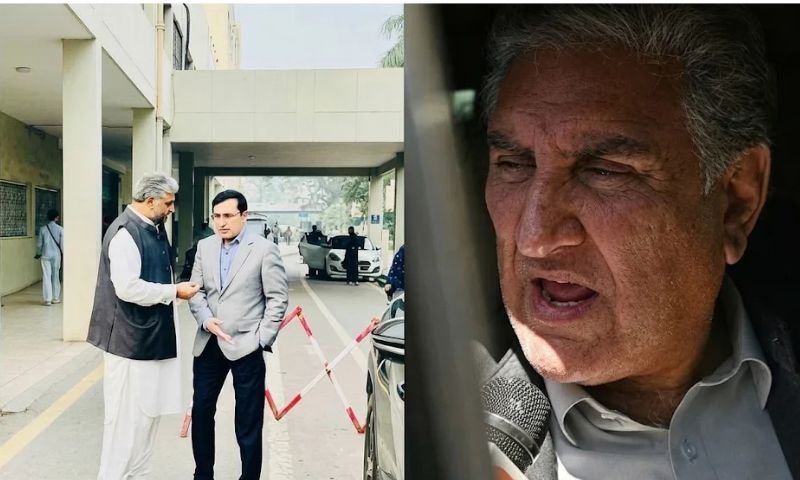

LAHORE: Pakistan Tehreek-e-Insaf (PTI) Chairman Barrister Gohar Ali Khan on Thursday visited party Vice Chairman and former foreign minister Shah Mahmood Qureshi at the Punjab Institute of Cardiology (PIC) in Lahore to inquire about his health, amid speculation about a possible easing of political tensions between the opposition party, the government and the establishment.
Barrister Gohar was accompanied by Qureshi’s son and PTI MNA Zain Qureshi during the visit. The former foreign minister is receiving medical treatment at the hospital.
The visit comes amid a series of developments involving the PTI leadership and the family of party founder Imran Khan, including the release of two of his sisters, his recent eye treatment and an extended meeting with his lawyers at Adiala Jail.
These developments have fuelled speculation about the possibility of renewed political engagement between the PTI and the government. However, no formal confirmation of any understanding or negotiations between the sides has emerged.
Qureshi was shifted from Kot Lakhpat Jail to the PIC for medical examinations after reportedly becoming dizzy and collapsing while walking inside his barrack, sustaining injuries to his knee and arm.
Jail authorities subsequently collected his blood samples and sent them to Shaukat Khanum Hospital for testing. His transfer followed demands by the PTI core committee for a comprehensive medical examination.
Qureshi had previously been taken to the same hospital in May 2025 after complaining of chest pain and shortness of breath.
Meanwhile, Imran Khan’s sisters Noreen Niazi and Uzma Khan were released from Lahore’s Kot Lakhpat Jail on Thursday. They had been detained under the Maintenance of Public Order (MPO) Ordinance, 1960, since September 21, 2026, following PTI protests demanding the former prime minister’s release.
Their release came after weeks of detention and legal proceedings, while their sister Aleema Khan remains in custody. A PTI spokesperson said the party had no information about when she would be released.
Imran Khan, meanwhile, underwent an eye treatment procedure during an overnight visit to the Pakistan Institute of Medical Sciences (PIMS) in Islamabad.
According to a hospital statement issued on Wednesday, the former prime minister was transferred from Adiala Jail to PIMS during the intervening night of November 10 and 11 for a medical examination and follow-up treatment on the advice of his treating ophthalmologist.
The medical development was followed by a nearly four-hour meeting between Imran and his lawyers at Adiala Jail on Wednesday, after the Islamabad High Court directed authorities to facilitate access to the incarcerated PTI founder and his wife, Bushra Bibi.
Senior lawyer Sardar Latif Khosa and Barrister Salman Safdar met the couple. Khosa later confirmed that the proposed 28th Constitutional Amendment had also been discussed, although he did not disclose Imran’s position on the proposed legislation.
Khosa said the meeting took place in a cordial atmosphere and lasted around four hours, with discussions focusing mainly on legal matters, pending cases and appeals. He added that Imran appeared alert and in good spirits but continued to complain about his eyesight and blood pressure.
Safdar said in a post on X that jail authorities had allowed him to meet Imran and Bushra Bibi from 4pm to 7pm. He said both had provided comprehensive legal instructions concerning their cases and confirmed that he would continue representing them in their main appeals in the Al-Qadir Trust case.
The developments coincide with reports that the government is preparing to introduce a proposed 28th Constitutional Amendment in Parliament, with the creation of new provinces among the issues under consideration.
Interior Minister Mohsin Naqvi has publicly called for the creation of new provinces through a referendum, arguing that the people should decide whether new administrative units should be established.
Speaking to reporters in Lahore, Naqvi urged political parties to seek public opinion on the matter, saying he would support whichever position the people endorsed. He said he would accept a public decision against new provinces, while public support would mean that new provinces should be established.
The interior minister also stressed that major political decisions would require consensus among coalition partners, including the Pakistan Muslim League-Nawaz (PML-N) and the Pakistan Peoples Party (PPP).
The proposed constitutional amendment could provide another avenue for political engagement, as any constitutional amendment requires a two-thirds majority in both houses of Parliament. If the ruling coalition cannot secure the required numbers independently, support from PTI lawmakers and other opposition parties could become important.
Political observers believe the government’s legislative agenda could create an opportunity for engagement with the PTI and potentially help ease tensions between the opposition party, the government and the establishment.
However, the recent developments do not establish that a political agreement has been reached or that formal negotiations are under way. Any meaningful improvement in relations will depend on the approach adopted by the government, the PTI’s response and the willingness of political stakeholders to find common ground.
