

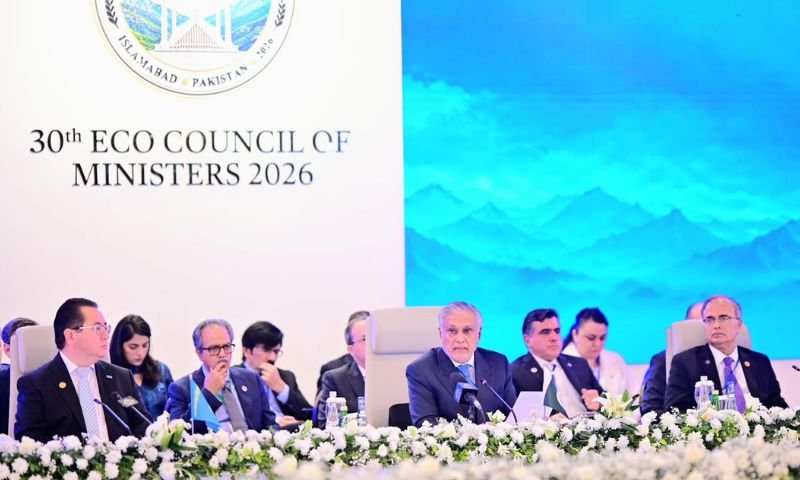

ISLAMABAD: Member states of the Economic Cooperation Organisation (ECO) have agreed to strengthen regional cooperation in artificial intelligence (AI), emerging technologies and digital security, while adopting a five-year roadmap to enhance collaboration in the minerals sector.
The commitments were outlined in the Islamabad Communiqué issued on Monday following the conclusion of the 30th Meeting of the ECO Council of Ministers, hosted by Pakistan in Islamabad on November 15-16.
The communiqué called on member states to promote cooperation in AI through the exchange of experiences and best practices, joint capacity-building initiatives, training and research programmes, including through the ECO Science Foundation and other relevant regional institutions.
It said such cooperation would help bridge the digital and artificial intelligence divide and enable countries across the region to benefit from emerging technologies for inclusive and sustainable development.
The member states also encouraged cooperation in the peaceful use of outer space, particularly satellite technologies and space-based services that could support regional connectivity, disaster risk reduction and environmental monitoring.
Emphasising the need to protect critical digital infrastructure and essential services, the communiqué called for stronger cooperation in information and communication technology (ICT) security through capacity-building, voluntary information-sharing, joint training and preparedness exercises.
It also stressed the importance of fair, transparent and non-discriminatory access to global markets for ICT security products, technologies and services, particularly for developing countries. Improved access, it said, would help address gaps in security capabilities, strengthen supply chain resilience and build trust among member states.
The communiqué encouraged international cooperation through knowledge-sharing, technology transfer and capacity-building, while cautioning against unjustified restrictions and unnecessary barriers to access to ICT security tools.
On regional connectivity, ECO members called for stronger multilateral diplomacy and outreach, alongside results-oriented partnerships with existing and prospective partners. They also emphasised the need to explore cooperation mechanisms for advancing transport and transit corridors and ICT initiatives across the region.
On energy cooperation, the communiqué urged member states to take greater ownership of major ECO energy projects and increase support for the ECO Clean Energy Centre (CECECO). It also called for the early launch of studies on the proposed ECO Regional Electricity Market (ECO-REM).
The member states welcomed the operationalisation of CECECO in Baku, noting that the centre would contribute to a sustainable energy transition, industrialisation, energy security and regional climate objectives.
A major outcome of the meeting was the adoption of the ECO Five-Year Roadmap on Minerals Cooperation for 2026-2030, described in the communiqué as the organisation’s first overarching and inclusive framework for regional cooperation in the minerals sector.
The roadmap covers mineral resources, including critical minerals required for advanced and emerging technologies, while reaffirming member states’ commitment to the sustainable management of mineral resources across the region.
On climate change, the ECO members called for stronger regional action on adaptation, combating desertification and reducing greenhouse gas emissions. The communiqué stressed that climate cooperation should reflect agreed principles as well as the national circumstances and priorities of individual member states.
It also called for improved access to climate finance, technology transfer on mutually agreed terms and capacity-building to help countries implement their national climate commitments and adaptation plans.
The communiqué recognised a High-Level Dialogue Platform on Environmental Cooperation, initiated by Uzbekistan, as a forum for bringing together stakeholders to exchange knowledge, share best practices and develop coordinated responses to regional environmental challenges.
The member states also highlighted the importance of preserving glaciers and other components of the cryosphere, particularly for sustainable development and climate adaptation in mountain regions.
They called for greater cooperation to assess the cross-border impact of glacier melting on regional water resources, alongside stronger scientific research, monitoring and information-sharing.
The ECO members underscored the need to advance the outcomes of the International Year of Glaciers’ Preservation 2025 and the Decade of Action for Cryospheric Sciences 2025-2034.
They further called for cooperation in training specialists, assessing climate risks associated with changes in glaciers and strengthening scientific observations, including through collaboration with the World Meteorological Organization and the United Nations Educational, Scientific and Cultural Organization.
The Islamabad Communiqué sets out a wide-ranging agenda for regional cooperation, covering emerging technologies, digital security, energy, minerals, transport connectivity and environmental protection.
