

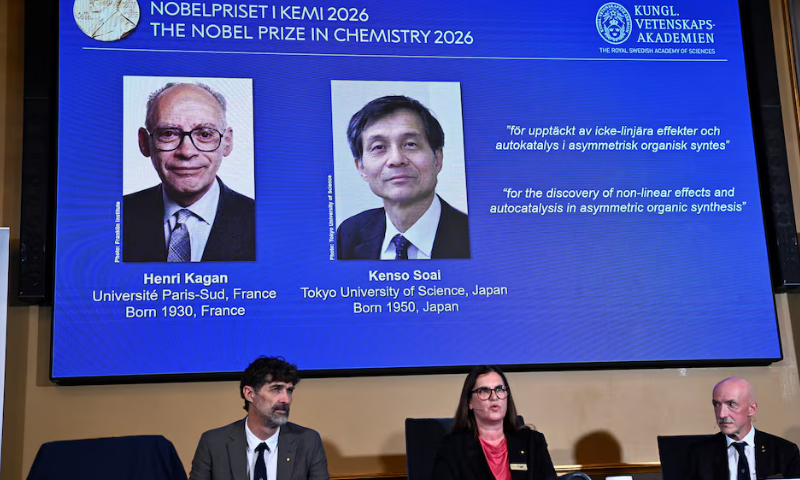

STOCKHOLM: Scientists Henri Kagan and Kenso Soai won the 2026 Nobel Prize in Chemistry for solving a long-standing riddle involving asymmetric “mirror-image” molecules, the Nobel Prize-awarding body said on Wednesday.
The discovery has proved important for pharmaceutical manufacturing, where producing the correct version of a molecule can determine how a drug affects the human body.
Soai, 76, is Japanese, while Kagan, 95, is French. Their work built on discoveries made by 19th-century French chemist Louis Pasteur.
“This is the most exciting day in my life, I am very glad to share this prize with professor Henri Kagan,” Soai said by phone during the Nobel Prize press conference, adding that he had been out shopping when he received the news.
The Nobel committee was still trying to contact Kagan to inform him of the award.
The chemistry prize, the third Nobel award announced during Nobel week, followed the prizes for medicine and physics announced on Monday and Tuesday.
Many molecules essential to life exist in two forms that are mirror images of each other, much like a left hand and a right hand. Living organisms, however, almost exclusively use only one version — a phenomenon known as “homochirality” — which has puzzled chemists for more than a century.
This year’s prize recognised discoveries showing how chemical reactions can be driven to favour a single molecular mirror image. Such techniques have become important tools for chemists developing reactions used in pharmaceutical production.
“The left-handed version of the drug can have one effect, and the right-handed version can have another effect, and then we need methods for selectively preparing them,” Peter Somfai, a member of the Nobel Committee for Chemistry, said.
“In developing such methods the findings of this year’s laureates are important. They provided powerful tools for that,” he added.
The work traces back to Pasteur, who studied tartaric acid, a substance important in wine production. He observed that bacteria fermented only one of two forms of tartaric acid — the form naturally found in grapes — while the other did not undergo fermentation.
The observation demonstrated that some substances occur in two mirror-image forms with different properties, which can in some cases have serious consequences for health.
The challenge of producing a desired form of a chiral substance remained unresolved until researchers including Kagan and Soai developed asymmetric reactions capable of producing an excess of one molecular form.
The importance of controlling molecular handedness was highlighted by the thalidomide scandal in the early 1960s, when thousands of children were born with birth defects after their mothers took the sedative during pregnancy. Subsequent research showed that the two mirror-image forms of the compound had different biological effects.
The Nobel Prizes, established through the will of Swedish inventor and businessman Alfred Nobel, have been awarded since 1901 for achievements in science, literature and peace, with interruptions mainly during the world wars.
Nobel, a chemist by profession, amassed his fortune through inventions, most notably dynamite. The economics prize was established later and is funded by Sweden’s central bank.
Although chemistry prizes can sometimes receive less public attention than awards in physics, literature and peace, the field has recognised major discoveries, including nuclear fission and techniques for genetic sequencing.
Last year’s chemistry prize went to Susumu Kitagawa, Richard Robson and Omar Yaghi for developing metal-organic frameworks, molecular structures with potential applications in addressing challenges including climate change and freshwater shortages.
The 2026 laureates will receive their medals from Sweden’s King Carl XVI Gustaf at a ceremony in Stockholm on December 10, the anniversary of Alfred Nobel’s death. The ceremony will be followed by a banquet at Stockholm City Hall.
The laureates will also share a prize of 12 million Swedish crowns ($1.2 million), in addition to the distinction of receiving one of the world’s most prestigious scientific awards.
The Nobel Peace Prize, the only Nobel prize presented outside Sweden, is awarded separately in Oslo.
