

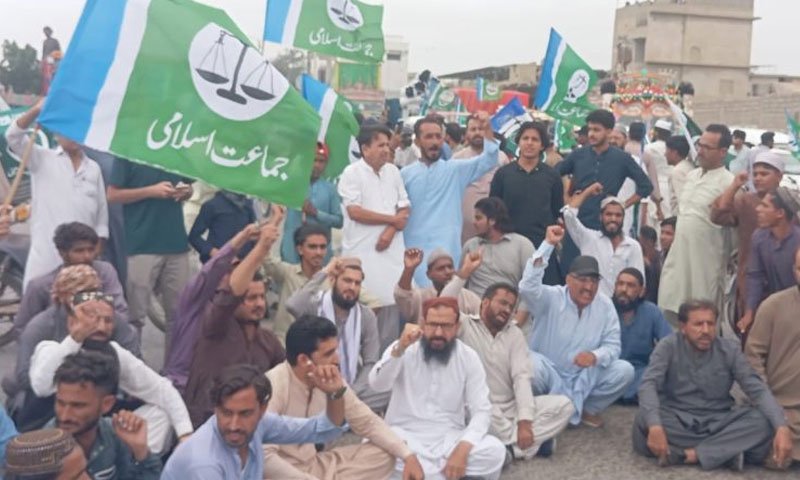

ISLAMABAD: Jamaat-e-Islami (JI) on Friday launched nationwide protests and sit-ins against the petroleum levy, rising electricity tariffs and inflation, triggering road blockades and severe traffic disruptions in several major cities across Pakistan.
Responding to JI chief Hafiz Naeemur Rehman’s call for demonstrations, party workers and leaders staged protests in Karachi, Lahore, Islamabad, Rawalpindi, Abbottabad and other cities, blocking key roads and highways as part of what the party described as a peaceful nationwide movement.
Hafiz Naeem said protests were being held at 510 locations across Punjab, Sindh, Khyber Pakhtunkhwa, Balochistan, Islamabad, Gilgit-Baltistan and Azad Jammu and Kashmir. He said the demonstrations were aimed at opposing the recent increase in petroleum prices, the petroleum levy, rising electricity tariffs and the growing cost of living.
He maintained that the protests would remain peaceful and instructed party workers to ensure ambulances and patients were allowed to pass through protest sites. He also warned authorities against attempting to stop the demonstrations, saying such actions could further escalate the situation.
In Islamabad, a sit-in at Motorway Chowk (26 Number Chungi) caused major traffic congestion, leaving hundreds of commuters and passengers travelling to and from Islamabad International Airport stranded. The protest was led by JI deputy chief Liaqat Baloch.
A brief face-off occurred between police and JI workers when law enforcement attempted to restore traffic flow. Addressing police officers at the site, Liaqat Baloch criticised the handling of the protest and said peaceful demonstrators should not be pushed towards confrontation.
He said Pakistan was facing multiple crises, claiming Balochistan was in turmoil while people in Azad Jammu and Kashmir were also protesting. He added that inflation, unemployment and poverty had become unbearable, with nearly 25 million children out of school. He urged the government to abolish the petroleum levy, reduce fuel prices and provide immediate relief to the public.
In Karachi, demonstrations disrupted traffic on Sharea Faisal, Hub River Road, Natha Khan, Orangi Town and several other major arteries. Protest caravans from different parts of the city gathered at Mazar-e-Quaid before marching towards Sharea Faisal, while police remained deployed across protest sites to maintain law and order.
Addressing protesters on Sharea Faisal, JI Karachi chief Monem Zafar Khan said the movement that began in Karachi had now evolved into a nationwide campaign against inflation, high fuel prices and rising utility costs.
He criticised the Sindh government over what he described as its failure to address Karachi’s longstanding issues, including poor public services, law and order, water shortages and street crime. He also criticised the privatisation of K-Electric, the e-challan system and the handling of recent high-profile crime cases.
In Lahore, JI workers staged a protest at Qurtaba Chowk on Ferozepur Road, causing heavy traffic congestion on Ferozepur Road, Main Boulevard Gulberg and MM Alam Road. The city traffic police advised motorists to avoid the affected areas and use alternative routes.
In Abbottabad, party workers blocked the Karakoram Highway, while protests and sit-ins were also held in Multan, Quetta, Peshawar, Bannu, Karak, Chakdara and several other cities.
According to the party spokesperson, demonstrations were planned at 510 locations nationwide, with provincial and district leaders leading the campaign. He warned that if authorities attempted to stop the peaceful protests, the movement could expand to 1,500 highways and roads across the country.
JI leaders reiterated that the protest campaign would continue until the government abolished the petroleum levy, reduced fuel prices and provided meaningful relief to citizens struggling with inflation and rising living costs.
