

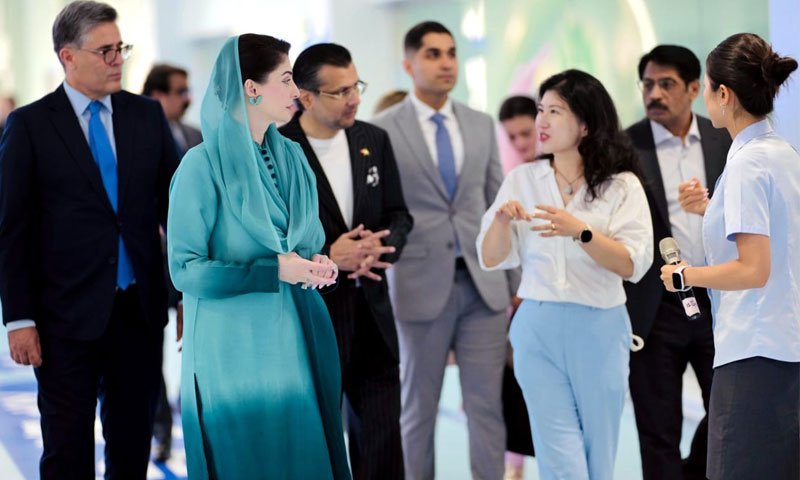

LAHORE: Punjab Chief Minister Maryam Nawaz Sharif has called for a new phase of Pakistan-China cooperation centred on data, artificial intelligence, technology and innovation, inviting Chinese technology companies and investors to partner with Punjab in developing its digital economy.
Addressing the China International Big Data Expo 2026 in Guiyang, known as China’s “Big Data Capital”, Maryam Nawaz said Punjab wanted to move beyond being a consumer of technology and become an equal partner in its creation and innovation.
She said Pakistan and China should build a new corridor of data, innovation and shared ideas alongside their existing physical and land-based connectivity.
“Punjab has enormous opportunities for Chinese companies,” she said, inviting Chinese technology firms, investors and infrastructure leaders to establish partnerships in the province and invest in energy, computing, cloud, connectivity and tokenisation infrastructure.
The chief minister said Punjab was determined to use technology to improve governance, transparency and public services, describing data as critical infrastructure rather than merely a technical or administrative resource.
She said the province was developing an autonomous, secure and intelligent digital foundation aimed at connecting reliable data with identity, public services, infrastructure, energy, financial systems and economic opportunities.
“Data should not merely be collected; it should be transformed into practical action,” she said.
Maryam Nawaz highlighted Punjab’s OneMap initiative, saying the provincial government was developing it as a state-level shared data engine that would integrate more than 12 terabytes of geospatial data and over 6,000 datasets from 31 departments.
She said the system could support better planning, help resolve land-related disputes and facilitate more informed urban development.
The government was also linking OneMap with the Punjab Socio-Economic Registry to better understand citizens’ needs, target resources effectively and ensure public services reached the right people, she said.
Maryam Nawaz said Punjab was simultaneously developing a Punjab Data Lake and establishing its first dedicated data centre to strengthen the province’s capacity to securely store, process and utilise data.
The government was also working on a sovereign cloud, digital identity system, interconnected government systems and an AI-based implementation framework, she said.
The chief minister said Punjab had become the first province to establish a dedicated AI Office aimed at placing artificial intelligence at the centre of governance.
According to her, the office would help improve decision-making, speed up public services, enhance transparency and make government more effective and accountable.
She cited Punjab’s Safe City programme as an example of how technology and AI-based analysis could deliver tangible public benefits.
“Through integrated systems and AI-based analysis, we are making our cities safer, improving emergency response and making policing more proactive and effective,” she said.
The chief minister said the real value of data would be demonstrated when it could help a businessperson establish financial credibility without traditional collateral, identify vulnerable families and deliver assistance more effectively, or provide farmers with timely information and targeted support.
She said data could also help tailor education to individual students, strengthen healthcare systems and enable environmental institutions to make evidence-based decisions rather than relying on estimates.
During her visit to China, Maryam Nawaz also led a delegation in a meeting with Huawei officials, where the two sides discussed expanding the Chinese technology giant’s partnership with Punjab.
The chief minister invited Huawei to make substantial investments in the Nawaz Sharif IT City, while discussions also covered the establishment of six data centres and a sovereign data centre there.
The two sides agreed on a strategic partnership aimed at equipping Punjab with artificial intelligence capabilities.
Under the proposed cooperation, Huawei master trainers will train 1,000 young people in Punjab, while 300 women trainers will receive AI training.
The meeting also discussed stronger coordination between government and business institutions and Huawei’s potential cooperation in smart cities, command centres, healthcare, education, agriculture and manufacturing.
The Punjab government and Huawei also agreed to designate a focal person to make cooperation between Huawei and the Government of Pakistan more effective.
Maryam welcomed Huawei’s commitment to Punjab’s digital transformation and reiterated that advancing the province in AI was among her government’s top priorities.
Provincial Special Assistant Ali Dar briefed the meeting on the AI Office, saying the Punjab government was working to ensure the use of AI in healthcare, education and governance.
He said Punjab offered significant opportunities because around 65 per cent of its population was young, creating a large potential talent pool for the technology sector.
In her Big Data Expo address, Maryam Nawaz stressed that the ultimate objective of digital transformation was not simply to accumulate increasingly large volumes of information but to turn data into economic and public value.
She said her experience of governing a province with a population of around 128 million had reinforced the importance of data-driven decision-making.
The chief minister noted that every dataset and algorithm ultimately affected people’s lives and therefore technology should be developed with practical public outcomes in mind.
Maryam Nawaz praised Guizhou for pursuing a data-driven development model and said Punjab intended to follow a similar path while adapting it to its own requirements.
She also linked the digital agenda to the broader Pakistan-China relationship, saying the two countries’ friendship was rooted not only in government-to-government ties but also in trust, mutual respect and relations between their peoples.
The chief minister said she was proud to carry forward the legacy of Pakistan-China friendship and take it into a new arena focused on data, technology and joint innovation.
She expressed hope that Pakistan and China would transform their shared vision of a digital economy into a new chapter of cooperation, innovation, development and shared prosperity.
