

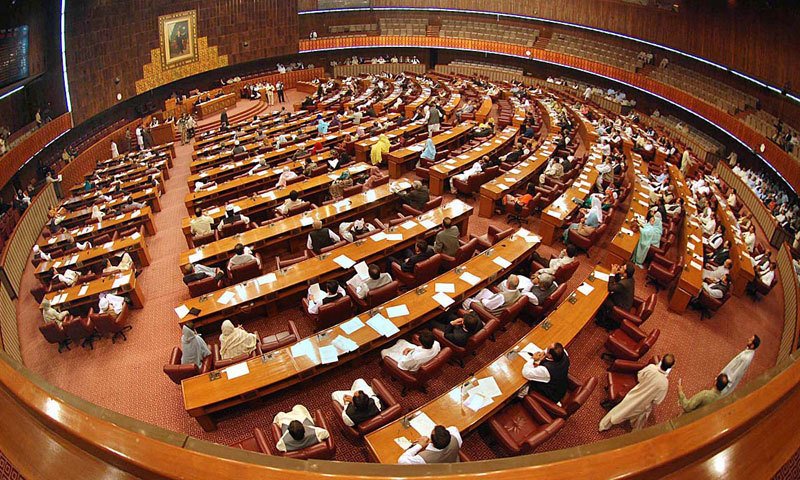

ISLAMABAD: The National Assembly on Thursday passed the Defence Forces Act 2026 and the National Command Authority Act 2010 Amendment Bill by a majority vote, bringing the existing legal framework in line with the new higher defence command structure introduced under the 27th Constitutional Amendment.
Defence Minister Khawaja Asif moved both bills in the House. Opposition lawmakers objected that they had not been given sufficient time to examine the proposed legislation, but the bills were passed despite their reservations.
The Defence Forces Act 2026 establishes a unified legal and administrative framework for the country’s armed forces. Under the law, a single Defence Forces Headquarters will be established to function under the command and authority of the Chief of Defence Forces (CDF).
The CDF will have operational command and control of the armed forces and will remain accountable to the federal government. The law also gives the CDF powers aimed at greater integration, operational coordination and joint functioning of the armed forces.
The 27th Constitutional Amendment abolished the office of Chairman Joint Chiefs of Staff Committee and created the post of Chief of Defence Forces, which is held concurrently by the Chief of Army Staff. Field Marshal Syed Asim Munir became the country’s first Chief of Defence Forces under the new arrangement.
The constitutional amendment also created the post of Commander of the National Strategic Command, a four-star position responsible for the operational integration of Pakistan’s strategic forces. Prime Minister Shehbaz Sharif last month promoted Lt Gen Syed Aamer Raza to four-star rank and appointed him as the country’s first Commander of the National Strategic Command.
The National Command Authority Act 2010 was also amended to bring its provisions in line with the new military command structure.
Speaking during the debate, Law Minister Azam Nazeer Tarar described the legislation as technical in nature and said the government had taken parliamentary leaders into confidence. He said the office of the Chief of Defence Forces had already been created through the constitutional amendment and the new legislation was intended to clearly define its powers and responsibilities.
PPP Chairman Bilawal Bhutto Zardari said the opposition had not been taken into confidence over the legislation. However, he supported the bills passed by the National Assembly.
Opposition Leader Mahmood Khan Achakzai objected to the manner in which the legislation was introduced, demanding that lawmakers be given sufficient time to study the bills. He called for the proposed legislation to be kept before the House for at least two or three days to allow proper debate.
At the outset of the session, National Assembly Speaker Sardar Ayaz Sadiq expressed displeasure over the absence of officials from the Ministry of Inter-Provincial Coordination during Question Hour and suspended proceedings for 15 minutes.
During Question Hour, Minister of State for Overseas Pakistanis Muhammad Awn Chaudhry told the House that financial assistance amounting to Rs1.3 billion had been provided to 3,498 families of Pakistanis who died abroad.
Lawmakers also raised issues concerning overseas Pakistanis, EOBI pensions, PIA flights during the Hajj operation and facilities at Karachi’s Jinnah International Airport.
The government informed the House that upgradation work was under way at Karachi airport. A new runway had been constructed, the lighting system for night-time landings had been improved and work on a new control tower was also being initiated.
The issue of Pakistanis deported from Gulf countries was also discussed, with officials explaining that the government maintains records of Pakistanis who are arrested, deported and subsequently handed over to Pakistani authorities.
The passage of the Defence Forces Act 2026 and the National Command Authority Amendment Bill marks another step towards providing statutory and administrative backing to the new defence command structure introduced through the 27th Constitutional Amendment.
