

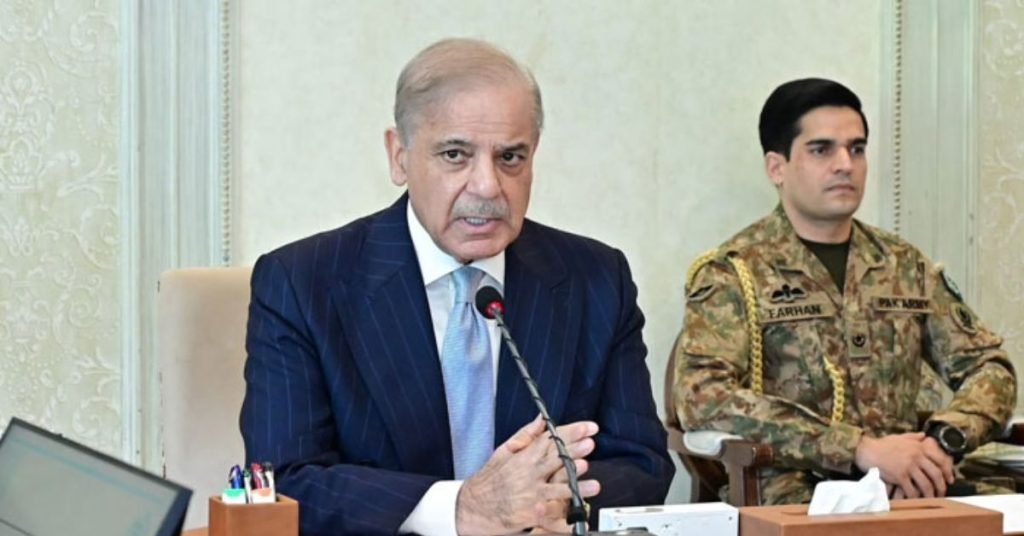

ISLAMABAD: Prime Minister Shehbaz Sharif on Wednesday chaired a high-level consultative meeting to review the situation in Khyber Pakhtunkhwa, with the federal government considering various constitutional and legal options amid the deteriorating security situation and the Pakistan Tehreek-e-Insaf’s planned long march on Islamabad on October 4, sources said.
Interior Minister Mohsin Naqvi, Law Minister Azam Nazeer Tarar, Information Minister Attaullah Tarar and Minister of State for Interior Talal Chaudhry attended the meeting, according to the sources.
Naqvi briefed the prime minister on the law and order situation in KP, while the law minister gave a briefing on constitutional and legal matters relating to the province.
The meeting also discussed backchannel contacts with PTI leaders and different legal and constitutional options for dealing with the situation in KP, the sources said.
The prime minister decided that all stakeholders would be taken into confidence before any decision was taken regarding the province. He is also expected to meet President Asif Ali Zardari on the matter, according to the sources.
The consultations come amid mounting tensions between the federal and PTI-led KP governments over security, governance and the PTI’s planned march on Islamabad.
The PTI has set October 4 for its long march after postponing its originally planned September 27 protest.
A day earlier, KP Chief Minister Sohail Afridi said the PTI’s planned long march would go ahead on October 4 “under all circumstances”, while urging supporters to participate peacefully.
“October 4 will happen,” Afridi said while speaking at a joint news conference with provincial Adviser for Finance Muzammil Aslam in Peshawar.
PTI Chairman Barrister Gohar Ali Khan also said the party’s call for the October 4 march remained intact. He said the party had repeatedly assured authorities that it would neither storm nor attack any location.
The federal government has meanwhile stepped up warnings that constitutional measures could be considered if the situation in KP deteriorates further.
Law Minister Azam Nazeer Tarar has said governor’s rule or an emergency could be imposed in the province if constitutional requirements were met.
KP Governor Faisal Karim Kundi has also warned the provincial government against pushing the situation to a point where governor’s rule becomes necessary.
Kundi has described governor’s rule as a “measure of necessity” and said the president could impose it on the prime minister’s advice if the situation warranted such a step. He also urged the PTI government to reconsider its plan to march on Islamabad given the province’s security situation.
The issue gained further political momentum on Wednesday when PPP Secretary General Nayyar Bukhari said his party would offer constitutional suggestions if the federal government consulted it over governor’s rule in KP.
Bukhari said governor’s rule could be imposed on the governor’s recommendation in case of failure of the provincial government. He described the law and order situation in KP as the “worst” and urged the federal government to enforce the law to prevent violence.
The federal government’s case against the KP administration has centred largely on the province’s security situation.
Information Minister Attaullah Tarar said on Monday that governance had failed in KP and accused the provincial government of not doing enough to counter terrorism.
He said the province had received additional resources through the National Finance Commission for counterterrorism and questioned how those funds had been utilised.
Tarar also referred to recent attacks in Kohat and Dera Ismail Khan and urged the provincial government to focus on areas where people were being killed instead of political activities.
He described governor’s rule as “premature” when asked about the possibility of imposing it, but maintained that the KP government had failed in several sectors, including health and education.
Tarar and Talal Chaudhry also criticised the PTI-led provincial government, accusing it of maintaining what they described as a “soft attitude” towards terrorists and Afghanistan.
Chaudhry questioned why the KP leadership did not publicly condemn attacks allegedly originating from Afghanistan, while Tarar demanded an account of resources allocated to the province for counterterrorism.
The two ministers also questioned the resources available to the KP Counter-Terrorism Department, including vehicles, protective equipment, training, forensic facilities and the Safe City project.
Tarar further alleged that political and financial interests, including illegal mining and contracts, were influencing the provincial government’s approach to terrorism.
PTI rejected the allegations, accusing the federal minister of political point-scoring and saying KP’s people, police and political workers had themselves suffered major losses in the fight against terrorism.
Chaudhry separately accused the PTI leadership of having a “soft attitude” towards Afghanistan and alleged that the provincial government had failed to stand united behind security forces.
The security situation has added further pressure on the provincial government following a series of deadly attacks in KP in recent weeks.
A September 18 attack on the old Police Lines in Kohat martyred at least 21 people, including 15 police personnel, while more than 100 people were injured. A subsequent clearance operation killed eight attackers.
On September 26, an explosives-laden vehicle targeted the Aman Mela checkpoint in Dera Ismail Khan’s Darazinda area. The attack was followed by firing on a Rescue 1122 ambulance carrying victims.
A subsequent FIR put the death toll at 14, with 35 people injured, and named unidentified militants allegedly affiliated with TTP-linked factions.
Three traffic policemen were also killed in an attack on a police vehicle in Tank on September 28, according to police.
The security situation is also linked to growing tensions between Islamabad and Kabul. Pakistan has accused the Afghan Taliban government of providing space to militant groups responsible for attacks inside Pakistan, allegations Kabul rejects.
Pakistan carried out air strikes in Afghanistan on September 24, saying it was targeting locations involved in launching and storing drones used against Pakistan. Kabul reported civilian deaths.
PTI has rejected the federal government’s allegations against the KP administration and said the province remains on the frontline of the fight against terrorism.
The party said its workers, elected representatives, police and ordinary citizens had made significant sacrifices and questioned the basis for accusing the entire provincial government of facilitating terrorists.
It has called for cooperation between the federal and provincial governments rather than political confrontation.
KP Chief Minister Sohail Afridi has also rejected the federal government’s counterterrorism approach, arguing that merely providing additional resources to police would not resolve the problem without a policy change.
At a law and order meeting in Peshawar on Monday, Afridi said his government had diverted Rs35 billion from the development budget to the police and claimed that allocations for the force had been doubled.
He called for a new counterterrorism policy involving the provincial government, administration and police.
PTI maintains that its October 4 march will be peaceful. Gohar said the party’s demands included allowing meetings with jailed PTI founder Imran Khan and providing him medical treatment.
He rejected the basis for imposing governor’s rule or an emergency and warned that PTI would resist such a move.
With the PTI march still scheduled for October 4, the federal government’s consultations have moved beyond public warnings to consideration of constitutional and legal options.
The prime minister’s decision to consult other stakeholders, including the president, indicates that the government has yet to announce a final course of action regarding KP.
Constitutional routes for emergency and governor’s rule
The Constitution provides two distinct mechanisms for extraordinary federal intervention in provincial affairs: Article 232, which deals with a Proclamation of Emergency, and Article 234, which covers a situation in which the constitutional machinery of a province has failed.
Under Article 232, the president may proclaim an emergency if satisfied that a grave emergency exists in which Pakistan’s security, or that of any part of the country, is threatened by war, external aggression or an internal disturbance beyond the power of a provincial government to control. Following the 18th Amendment, an emergency on the basis of internal disturbance ordinarily requires a resolution of the relevant provincial assembly. If the president acts on his own, the proclamation must be placed before both houses of Parliament for approval within 10 days.
While an Article 232 emergency is in force, Parliament may legislate for the affected province on matters outside the Federal Legislative List. The federal executive authority also extends to giving directions to the provincial government, while the federal government may assume some or all functions of the provincial government or direct the governor to exercise those functions on its behalf.
An emergency proclamation must be laid before a joint sitting of Parliament, which is to be summoned within 30 days. It ceases to be in force after two months unless approved by the joint sitting. The Constitution contains a separate four-month provision where the National Assembly is dissolved when the emergency is proclaimed.
Article 234 deals with failure of constitutional machinery. If the president, after receiving a report from the governor, is satisfied that the provincial government cannot be carried on in accordance with the Constitution, the president may issue a proclamation. The president may assume some or all functions of the provincial government or direct the governor to exercise those functions on the president’s behalf.
Article 234 also allows a proclamation to provide that the powers of the provincial assembly are to be exercised by or under the authority of Parliament. The constitutional provision therefore differs from Article 232 in its trigger and the mechanism through which provincial functions and legislative authority may be transferred.
An Article 234 proclamation must be laid before a joint sitting of Parliament and expires after two months unless approved. Once approved, it can be extended through further resolutions, subject to the constitutional limits on each extension and the overall period.
Both mechanisms contain protections concerning the High Courts. Neither permits the president or governor to assume powers vested in or exercisable by a High Court or to suspend constitutional provisions relating to High Courts.
The Constitution also contains historical notes relating to the use of Article 232 in the former NWFP in 1975 and Balochistan in 1976, with the relevant orders subsequently rescinded.
The current debate over KP therefore concerns two constitutionally distinct routes rather than a single mechanism commonly referred to as “governor’s rule”. Article 232 concerns an emergency arising from specified threats to security, while Article 234 concerns the failure of constitutional machinery in a province. The precise legal route, if any, would depend on the circumstances and the constitutional requirements applicable at the time.
